Month: November 2009

  • Garden Club of the Back Bay Holiday Wreaths – More Reasons to Buy

    We are often asked “What does the Garden Club do?”  Throughout this web site, you will find much information about our mission and our projects, but essentially we are all about the trees.  Previously we explored our pruning project, and today we’d like to introduce you to the magic of mulch, and why we do it.

    When we plant a new street tree on the sidewalks of the Back Bay (and we plant, on average, ten new trees a year in empty tree pits), we install a PVC pipe perforated with holes and topped with a removable cap to facilitate deep watering.  We contact abutting neighbors and find a good citizen willing to provide auxiliary water to the newly planted tree for a period of two years, and then we mulch.  The mulch moderates the temperature of the soil surrounding the tree and lessens evaporation, very important on hot summer days.  A young tree undergoes the same transplant shock that flats of flowers do, but while a small pansy plant can recover rapidly with a quart of water, the tree needs far more moisture to thrive.

    Needless to say, mulch isn’t free.  We purchase bales and bales of mulch and volunteer members clean out the tree pits (cigarette butts are but one of many unmentionable bits of garbage we find discarded next to our beloved trees) and add a few inches of mulch, carefully keeping the mulch away from the bark so we don’t promote rot.  That mulch money comes, in part, from your support of our Holiday Wreath sale, and we hope that, when you decide to purchase one of our gorgeous wreaths, you’ll think of how grateful the young trees will be when they are tucked in to bed with their blankets of mulch.  Click here to order.

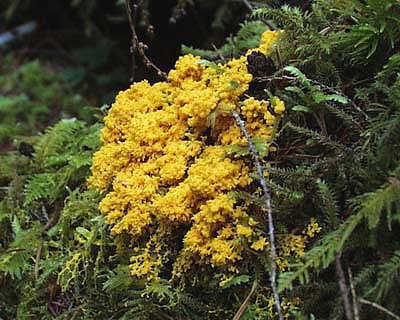
  • Saturday, November 21, 1:00 pm – Myxomycetes! The Enigma of Slime Molds

    In this illustrated talk, David Rose, past president of the Connecticut-Westchester Mycological Association (COMA), will explore the natural history of myxomycetes, commonly known as “slime molds.” Slime molds are colorful harmless organisms that inhabit damp woodland environments. So perplexing to science that they have been classified variously as animals, plants, and fungi (they are actually protists), these organisms are remarkable for their delicate beauty and their surprising transformation from an animal-like to a plant-like stage. Though they are not mushrooms, slime molds reproduce by spores and have traditionally been studied by mycologists for their resemblance to the fungi.  The program will be held Saturday, November 21 beginning at 1:00 pm at the Connecticut Agricultural Experiment Station, 123 Huntington Street, New Haven, Connecticut, and is free and open to the public.

    http://upload.wikimedia.org/wikipedia/commons/8/84/Slime_Mold_Olympic_National_Park_North_Fork_Sol_Duc.jpg

  • Friday, November 20, 7:00 – 8:30 pm – Kodo: An Evening of Incense Appreciation


    KyotoGardensMr. Masataka Hata, President of the Shoyeido Incense company of Kyoto  will  present an evening devoted to the lore of traditional Japanese  incense appreciation.  Shoyeido began in Kyoto in 1705.   Rokubei Moritsune Hata began incorporating methods  he learned while working at the Imperial Palace in Kyoto. He applied the court’s secret traditions of blending incense, previously enjoyed  only by royalty, to commercial production.  Twelve generations later,  Masataka Hata continues this legacy, and Shoyeido today offers customers a wide variety of high quality, unique, hand-blended incense.  Mr. Hata will be joined in this program by Hachiya Sohitsu, the young master of the Shino School of Incense Appreciation.  The program will be in two parts:  first, participants will engage in the classic incense game known as “kumiko” or “genji-ko,”  a favorite pastime of courtiers, as depicted in The Tale of Genji.  The incense game will take place in  Showa Boston’s  beautiful Sanzashi-an tea-ceremony rooms.  A more perfect setting for experiencing incense as it was known to Prince Genji and Lady Murasaki does not exist in New England.  Part two will be a brief workshop in making Japanese incense sachets.

    $30 for the Public
    $15 for Japan Society Members
    For more information, log on to www.us-japan.org.
  • Wednesday, November 18, 12 noon – 1:30 pm – Asian Longhorned Beetle: Identification and Controls

    Unable to to come to the Commonwealth Avenue Mall on Saturday morning at 9 am, November 14 for the Asian Longhorned Beetle Battle?  If you are yet unsure what the dread Asian Longhorned Beetle looks like, you have a second chance. Come to Garden in the Woods, 180 Hemenway Road in Framingham, on Wednesday, November  18 at noon for a one and one half hour lesson and lecture.  Hear what is being done to control this damaging pest.  Bring a brown-bag lunch.  There is no cost, but pre-registration is necessary.  Call 508-877-7630, ext. 3303, or email registrar@newenglandwild.org.  For more information, log on to www.newenglandwild.org.

    http://www.forestresearch.gov.uk/images/Asian_longhorn_beetle250.jpg/$FILE/Asian_longhorn_beetle250.jpg

  • Saturday, December 5 – Sunday, December 6, 8:00 am – 5:00 pm – NABB’s Annual Christmas Tree Sale

    The Neighborhood Association of the Back Bay will hold its Annual Christmas Tree Sale at the Clarendon Street Playground on Saturday, December 5 through Sunday, December 6, from 8:00 am – 5:00 pm.  NABB Director Chris Mitchell will once again bring in fresh-cut balsam fir trees from the State of Maine, with all proceeds benefiting The Neighborhood Association of the Back Bay.  Local deliveries are available.  If you would like an extra tall tree, please call Lois Harvey at the NABB office (617-247-3961) before Thanksgiving to put in a special order.  For more information, log on to www.nabbonline.com.

    http://www.anthonystreefarm.com/images/Balsam_Fir.jpg

  • Wednesday, December 2, 9:30 – Sogetsu Ikebana Workshop

    Jennie Sterling will hold a workshop at the University of Massachusetts Waltham Center, 240 Beaver Street in Waltham, on Wednesday, December 2, beginning at 9:30 am.  Reservations are necessary, and for more information, including details on joining Ikebana International Boston Chapter, log on to www.ikebanaboston.org, or contact President Kaye Vosburgh, vosburghk@aol.com.

    http://www.burrinja.org.au/arts/Content/jarmbi/content/current/current_exhib_files/ikebana1.jpg

  • Tuesday, December 1, 9:30 am – Sogetsu Ikebana Demonstration

    Ikebana International, Boston Chapter, will sponsor a Sogetsu Ikebana Demonstration on Tuesday, December 1, beginning at 9:30 am, at the University of Massachusetts  Waltham Center, 240 Beaver Street in Waltham.  Jennie Sterling will display her art, and guests are welcome.

    “Of all Japan’s traditional arts, perhaps the most famed and actively practiced today is IKEBANA, the art of flower arrangement. While tracing its origins back for hundreds of years, it still exists as a vital element in the contemporary world of art. It has emerged from its historical setting within the “tokonoma” alcove of the Japanese house and entered the modern everyday world: the office window or conference room, the hotel lobby or public square. In the same way, Ikebana is no longer the exclusive province of arrangers or artists in Japan, but counts among its devotees professional and amateur designers in all nations and walks of life. This added dimension to the use and meaning of Ikebana has in no way altered those fundamentals of structure, space and naturalism, which have been developed over the centuries.

    In basic form, an Ikebana arrangement follows a fixed pattern: a triangle of three points. Emphasis is placed on linear perfection, color harmony, space and form. If commonplace branch material is arranged in a beautifully flowing line, it takes preference over a mass of blooms or blossoms, regardless of their beauty. Of equal importance is the sense of naturalism: an arrangement encompasses nature in all its aspects – from the tall stately pine to the lowliest blade of grass. Further, an Ikebana usually contains the foliage and flowers of the season at hand, used in their natural state expect for the deft “cut” of the arranger’s clippers, which perfects the line of a branch or the shape of a bud.

    There are numerous schools of Ikebana, each following a particular set of rules and arranging techniques, but without losing sight of the fundamentals of the art. And in keeping with the broader emphasis being given to Ikebana in its role in contemporary living, many of these schools seek expression in forms that reach beyond traditional styles.”  From: Ministry of Foreign Affairs of Japan.

    For information about the program and about Ikebana International, log on to www.ikebanaboston.org.

  • Thursday, November 19, 5:00 – 7:00 pm – The Boston Harbor Association Annual Meeting

    Join The Boston Harbor Association for its 2009 Annual Meeting. Reception begins at 5 p.m., followed by short business meeting and program at 6 p.m. Free, registration required at mail@tbha.org (note: priority to TBHA members, but the public is invited).  The event will take place at North Coast Seafoods, 5 Drydock Avenue in Boston (picture below).

    http://www.hhbuilders.com/images/NorthCoastSeafood10.jpg

  • Saturday, November 21, 10:30 – 12:30 pm – Specialty Perennials: Five Genera for the Shade

    Many excellent perennials thrive in the shade. A continuation of bloom with outstanding foliage is the dream of many gardeners. Exciting new cultivars will be featured including many rare forms of Polygonatum, Astilbe, Anemonella (below), Primula sieboldii and hardy Arisaema. This lecture at the Berkshire Botanical Garden in West Stockbridge, Massachusetts will focus on specialty perennials for the shade border. Learn from an expert propagator. Leo Blanchette is the owner and propagator of Blanchette Gardens in Carlisle, Massachusetts a nursery specializing in perennials. It features numerous rare and unusual varieties. He lectures through out the United States as well as in Canada and Japan. He was awarded the Silver Medal from the Massachusetts Horticultural Society, the Bronze Medal from the American Rhododendron Society and he has been featured in national gardening magazines.  The lecture will take place Saturday, November 21 beginning at 10:30 am, and will cost $20 for BBG members and $25 for non-members.  For more information, log on to www.berkshirebotanical.org.

    http://www.alpinegardensociety.net/image_files/showreport/sizedAnemonella%20thalictroides%20-%20Ian%20Leslie1420.jpg

  • Saturday, November 21, 1:00 – 5:00 pm – Laura Coombs Hills: Portraits from My Garden

    The Cooley Gallery, 25 Lyme Street, Old Lyme, Connecticut is extraordinarily excited to announce a landmark new exhibition of pastel work by Laura Coombs Hills.  Portraits from My Garden will be the largest solo exhibition and sale of Hills’ unparalleled floral pastels in nearly seven decades.  You are cordially invited to the open house reception on Saturday, November 21, from 1-5 pm.  The show will run through January 2, 2010, and you can see a preview exhibition on November 12 at the Cooley Gallery booth at the Boston International Fine Art Show at the Cyclorama, 539 Tremont Street in Boston.  The exhibit is produced in conjuction with Vincent Vallarino Fine Art, LTD and Lepore Fine Art.

    Sandra Lepore writes: “Rendering flowers in pastel became Hills primary artistic concern. Lizzie carefully cultivated and nurtured favorite specimens — peonies, lilies, larkspur, Van Fleet and tea roses, zinnias, and dahlias — at “The Goldfish.” Cut early in the morning, still glistening with dew, the blooms were carefully arranged in full sunlight for optimum vibrancy and contrast. Hills occasionally added an electric bulb to enhance the lighting effect. “It woke those lilies up,” she said, “[and] made them speak.”  Hills worked quickly, laying colors with her pinky poised for selective blending. She paid considerable attention to backdrops: employing scarves, tapestries, and fabrics she had collected on her various trips to Europe.

    Beginning in 1921, Hills began an almost unbroken string of annual solo exhibits in Boston, each extremely successful from a sales standpoint. In her 1927 Copley Gallery exhibition, only five of forty-five floral pastels remained after noon on the first day.”  The image below is courtesy of Childs Gallery, Boston.

    [Pink Flowers in Vases]