Month: April 2022

  • Saturday, May 7, 7:00 pm – Public Gardens in Today’s World, Online

    Saturday, May 7, 7:00 pm – Public Gardens in Today’s World, Online

    The New England Botanical Club will hold its next meeting on Saturday, May 7 at 7:00 pm Eastern Time via Zoom. Non-members may register for the meeting access link here. William Cullina will speak on Public Gardens in Today’s World.

    William Cullina is the F. Otto Haas Executive Director of the Morris Arboretum of the University of Pennsylvania. For eleven years prior, Bill was at Coastal Maine Botanical Gardens, as Director of Horticulture and Plant Curator and then as President and CEO. Cullina holds degrees in plant science and psychology; he has been working in public horticulture for 25 years. He has extensive experience in horticultural and forestry research and commercial nursery production, including, I’m sure you will remember, at The New England Wild Flower Society, now the Native Plants Trust.

    A well-known author and recognized authority on North American native plants, Cullina lectures on a variety of subjects to garden and professional groups and writes for popular and technical journals. His books include Wildflowers, Native Trees, Shrubs, and Vines, Understanding Orchids, Native Ferns, Mosses, and Grasses, and Understanding Perennials. Bill Cullina will discuss the increasingly critical role that public gardens play in American society. He will consider biophilia: the affinity of human beings for other life forms and what this means for public gardens. He will also reflect on ways that gardens provide accessibility, improve physical and mental health, engage in critical research, and provide space for quiet joy and transcendence.

  • Monday, May 2, 1:00 pm – The History of the Rose, Online

    The rose is the world’s favorite flower and always has been. It is the greatest floral symbol of love and romance the world over and touches people’s hearts at many points in their lives: the flower most often chosen to celebrate significant milestones, such as weddings or anniversaries, and to mark births and deaths. This talk will trace the journey of the rose across the centuries, from battles to bouquets, charting its botanical, religious, literary and artistic history. Dr Catherine Horwood will explore the story of what makes this botanical family so loved: from Cleopatra’s rose-petal-filled bed to Nijinsky’s Spectre de la rose ballet; from the highly-prized attar of rose oil so believed by the ancient Persians to top-brand perfume labels today; and from Shakespearean myths about the Wars of the Roses to the significance of Queen Elizabeth’s I’s embroidered dresses.

    The Gardens Trust in association with the Historic Roses Group presents this online talk on May 2 at 1 pm Eastern time. £5. Register through Eventbrite at https://www.eventbrite.co.uk/e/the-rose-the-history-of-the-rose-tickets-305563497647

    Dr Catherine Horwood is an experienced speaker and the author of many books on social history including Gardening Women: Their Stories from 1600 to the Present (Virago, 2010) and Potted History – How Houseplants Took Over Our Homes (Pimpernel Press, 2020). Her biography Beth Chatto: A Life with Plants (Pimpernel Press, 2019) was selected as the European Garden Book of the Year in 2020. She is also author of Rose (Reaktion Books, 2018), which was described by Gardens Illustrated as ‘a clearly-written, information-packed review of the historical, religious, cultural and artistic significance of the world’s favourite flower’.

  • Sunday, May 22, 10:00 am – 4:00 pm – Garden Conservancy Boston-area Open Day

    Register now for the May 22 Garden Conservancy Open Day and especially for the Digging Deeper program from 12 – 2 on Croquet and Cocktails: Preserving and Restoring Sporting Greens, since tickets are limited and sell out early. For each garden access, the fee is $5 for Garden Conservancy members, $10 for nonmembers.

    • Pre-registration is REQUIRED for each garden. Pre-register for each HERE, except where specifically indicated otherwise. Children under 12 are free and do not need to be pre-registered if accompanied by pre-registered adult.
    • Capacity is limited. Sorry, no walk-ins allowed; no paper tickets or cash payments will be accepted on-site.
    • Masks are required, at the discretion of the garden owners, and social distancing is encouraged at all in-person events.

    The first on the list is the Spalding Garden in Milton. Designed by renowned landscape architect Fletcher Steele in 1924, the Spalding Garden was rescued from demolition in 2005 by the Milton Garden Club. A cultural landscape report was commissioned, and preservation efforts began shortly thereafter and continue at present. The garden, as it remains, stands on half an acre and includes formal gardens bordered by mature boxwoods, a perennial garden, a bowling green, and much of the original brickwork. In acquiring the garden, it has been the Milton Garden Club’s mission to create a pilot project to demonstrate the importance of saving local period landscape from development, to educate the public, and to adopt sustainable practices that set community standards for gardening and preservation. This is the site of the Croquet and Cocktails event ($30 Garden Conservancy members, $40 nonmembers).

    In Boston proper, visit the Dustman-Ryan Garden, known as The Artful Garden. This garden reflects the creative efforts of a mighty team: Christie Dustman, professional garden designer, and Patti Ryan, a professional furniture maker. In their own personal garden, these two artists have let nothing hinder their zeal for plants, stone, and whimsy. The garden is in its eleventh season, and its transformation was done in phases, keeping only a privet hedge and one andromeda. The garden uses plants and objects as sculptures in an array of vignettes and intentional views. By showcasing some plants and objects against a background of other plants and elements, this garden has many levels of complexity and interest. The owners are members of the Conifer Society, and you will find more than 50 different conifers, as well as rare and unusual plants. It is the reclaimed and castoff items used as art and decoration, like basketball hoops and organ pipes, that often command the most “ooohs and ahhhs.” Garden is partially accessible.

    Fairview Garden is located right in Roslindale. Tucked a few steps from the Peters Hill gate of the Arnold Arboretum, is a peaceful oasis of a garden. The owner began gardening about 18 years ago, initially inspired by perennials gifted from neighbors. You will be greeted with the varied colors and textures of maturing weeping conifers. Look for the swirling umbrella pine and colorful Japanese maple. A newer front bluestone walkway leads to a fieldstone wall, and in back there is a sense of quiet awe with dappled sunlight and subtle splashes of color. Zen statuary and handmade trellises support an extensive clematis display and give a Japanese feel to the garden. Garden is partially accessible.

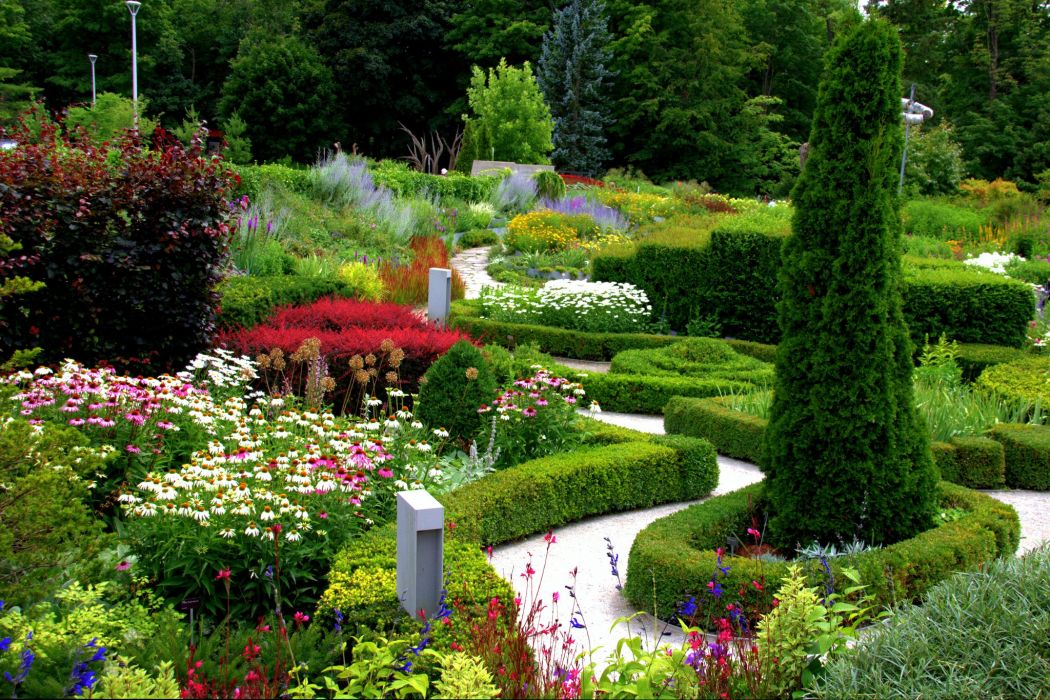
    In West Roxbury, the James/Raverso Garden (below) will be on view. This romantic urban escape with eye-popping color provided by hundreds of annuals, perennials, roses, and vines is viewed from a double-layered backyard deck that engages seamlessly with the surrounding gardens. Inspired by the classic “over the top” layered floral displays in English country gardens, it has taken eight years to build up four distinct garden areas that surround this Boston home. Definitely not a “low maintenance” garden, variations of color and texture provide a never-ending display from early Spring to late November.

  • Wednesday, May 4, 1:00 pm – Medieval Splendour: London’s Palace Gardens and Royal Beasts, Online

    Would you expect to find a dragon in a Richmond Garden? A greyhound on a pole in Westminster? Or a griffin lurking in a hedge in Bexley? Probably not: but all those beasts and many more lived in the gardens of Tudor royal palaces and aristocratic mansions. Find out how and why in this lecture by David Marsh which will explore one of the most visually spectacular aspects of late 15th and 16th England and their legacy in gardens since then.

    Dr. David Marsh researches, lectures and writes on any and all aspects of garden history, and helps organize the Garden History seminar at London University’s Institute of Historical Research. He is a trustee of the Gardens Trust and organizes their extensive on-line program. For the last eight years he has also written a weekly garden history blog for them which you can find at thegardenstrust.blog

    This talk is the first in our series on Wednesdays presented in association with London Gardens Trust £5 each or all 4 for £16. Register through Eventbrite HERE. Attendees will be sent a Zoom link 2 days prior to the start of the talk, and again a few hours before the talk. A link to the recorded session (available for 1 week) will be sent shortly afterwards.

  • Sunday, May 1, 1:00 pm – 3:00 pm – Flower Color Theory with Michael and Taylor Putnam

    As part of this year’s Art in Bloom celebration at the Museum of Fine Arts, Boston, sign up for a lecture and floral demonstration with world-famous floral designers Michael Putnam and Taylor Putnam who share their creative techniques for using color to inspire breathtaking, romantic floral arrangements. Book signing to follow. The event will be in the Harry and Mildred Remis Auditorium, Auditorium 161, on May 1 from 1 – 3, and you may order tickets by phone at 1 – 800 – 440 – 6975, or online at www.mfa.org. $40 for MFA members, $50 for nonmembers, $6 processing fee for phone orders.

  • Wednesday, May 11, 7:00 pm – Bat Falcon, Social Flycatcher oh my!, Live or Online

    Athol Bird and Nature Club members Ernie Leblanc, Jeff Johnstone, Bob Mallet and Dave Small ventured to the Rio Grande Valley of Texas in search of these and other rare and unusual birds in early March. Ernie will guide us on a recap of this whirlwind and successful adventure. In person at the Millers River Environmental Center 100 Main Street Athol 01331 or via Zoom.

    When: May 11, 7:00 PM Eastern Time (US and Canada) Register in advance for this meeting:https://us02web.zoom.us/meeting/register/tZAlce2prj8jGN2nAoZTwJDynr2J2nteJemh  After registering, you will receive a confirmation email containing information about joining the meeting.

  • Monday, May 16, 7:00 pm – Director’s Series – Life: The Arnold Arboretum as an Institution of Public Health

    Join the Arnold Arboretum’s Director William (Ned) Friedman for the annual Director’s Series! To celebrate the Arboretum’s sesquicentennial, this year’s series will explore the Magic and Meaning of a Garden of Trees. Over the course of four sessions, we will trace the Arnold’s significance in the landscape architecture movement, value for the people of Boston, and leadership in creating global connections between plants and people. This session will include brief presentations and a moderated panel. The program is free and is offered both in person and livestreamed. 

    Panelists:

    • Dr. Michelle Kondo, Research Social Scientist, UDSA-Forest Service
    • Rev. Mariama White-Hammond, Chief of Environment, Energy, and Open Space, City of Boston
    • Laurence Cotton, Consulting Producer, “Frederick Law Olmsted: Designing America,” PBS

    Moderator: Dr. William (Ned) Friedman, Director, Arnold Arboretum

    To sign up for the virtual event, click HERE. This event will also be presented in-person at the Arboretum’s Weld Hill Research Building at 1300 Centre Street, Boston, MA 02131. To sign up for the in-person event, click here.

  • Friday, May 13, 10:00 am – 12:00 noon – Hands-On Hydrangeas: Container Growing Workshop

    Of all the hydrangea species, H. macrophyllas are the best suited to container growing. This method is the surest way to obtain reliable blooming – even on Cape Cod!

    The blooming beauty of the H. macrophylla is especially appreciated when located nearby – like on your deck, patio, or porch. In groups, you can move them around to achieve varied flower displays and can adjust for changing sun and or shade conditions as the growing season progresses. Given reliable care, this species can remain in the same pot for several years. Many cultivars even prefer being “root constrained,” often flowering better than when planted in the ground.

    Best of all, container growing provides an effective “mobility factor” – a comparatively easy and efficient way to move and protect these cold-sensitive plants from winter. Curator of Hydrangeas, Mal Condon, and guest expert, Linda Coven (owner of Strictly Hydrangeas) are particularly fond of this growing method and have developed superior ways to enhance the growth and protection attributes through the “Pot-N-Pot” and “Bag-N-Pot” growing techniques that they will share in detail. In the hands-on portion of this workshop, participants will get to create their own container arrangement with provided materials, including a grow bag, hydrangea, companion plants, and soil mix all provided in the class. NOTE:  participants should bring their own decorative pots in which to plant.

    In addition to creating a container planting to take home, this May 13 Heritage Museums & Gardens in-person workshop includes time for questions and a hand-out of information for your reference. Advance registration is required and spots are extremely limited. Don’t miss this important “how-to” workshop – register today!

    Please note:  this program will take place outdoors, and involves hands-on garden work – be sure to dress accordingly (in layers) and bring two pairs of gloves. In the event of severe inclement weather, this course will be rescheduled to the following day, Saturday, May 14, from 10 am-noon.

    Program fees fund Heritage’s mission to inspire people of all ages to explore, discover, and learn together. Thank you for your support. Program Registration Fee: $68 Members, $75 Non-Members Register HERE. Registration for this class will open at 6:45 am on April 27.

  • Fridays, May 13 & 20, 10:30 am – 12:30 pm – Summer Blooming Native Plants, Online

    Discover plants native to our region that flower in summer, such as Hairy Penstemon, Spotted Beebalm, Shrubby St. John’s Wort, and Northern Bush Honeysuckle. Learn how to choose the right plants for your landscape conditions and explore the benefits they provide to your garden’s ecosystem for pollinators, birds, and other wildlife. This New York Botanical Garden online two session class takes place May 13 and 20 from 10:30 – 12:30 with instructor Kim Eierman of EcoBeneficial. NYBG members $79, nonmembers $85. Register HERE.