Category: Archives

  • From the Archives: Window Boxes

    From the Archives: Window Boxes

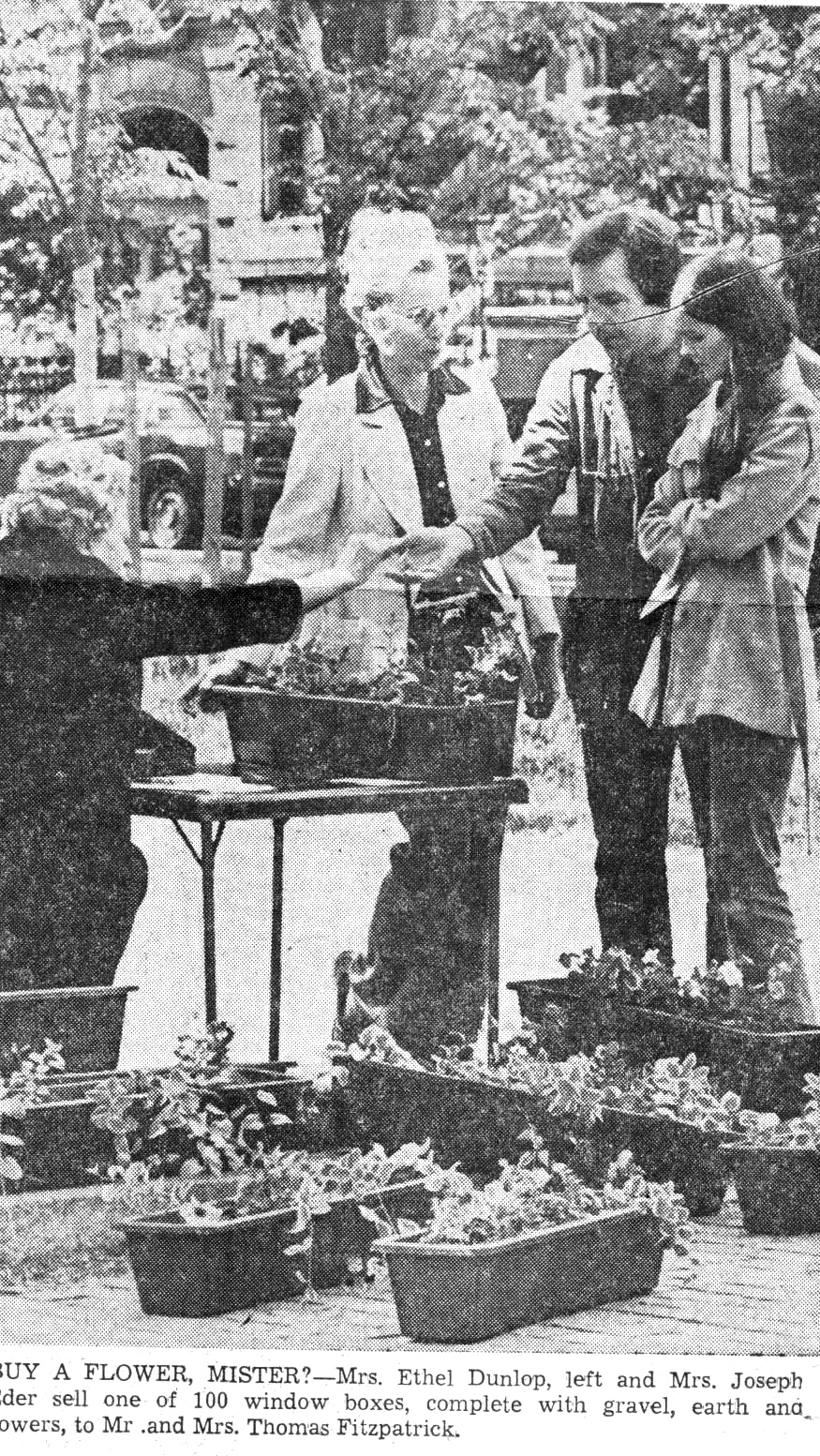
    In May, 1973, as part of a planting project on Beacon Street which we will describe in a future “From the Archives” post, the Garden Club of the Back Bay sold window boxes to neighbors. Then-President Patsy Boyce admitted the idea was borrowed from the Beacon Hill Garden Club, and the boxes themselves were made by the North American Rockwell Corporation of Linesville, Pennsylvania, the same company BHGC used.  Included with each box was an eight page brochure on installing window boxes, and what to grow in them, including maintenance hints.

    Below is a shot of former Club members Ethel Dunlop and Ruth Eder selling one of 100 available window boxes to the Kilpatricks.

    window boxes

    Save

  • From the Archives – Front Yard Clean Up

    Gone are the days when Garden Club of the Back Bay members ventured out to clean up the neighbors’ front yards. In April of 1972, the following notice was sent the members:

    “On Saturday, May 6th, the joined forces of our small group should be able to make a large impression on our neighborhood by a front yard clean up. Hopefully in one fell swoop we will be able to … improve the front yards of our Back Bay.  We are looking for a member or volunteer to do one half of each block.”

    Beige polyethylene garbage bags were put in the front hall of each Back Bay building.  On the front of the bag was a self sticking Garden Club of the Back Bay label.  An attached flyer stated that yard waste was to be put in the bag for pick up by a Garden Club volunteer three days later.  The bags then went into the alleys for pickup by the City.

    Assuredly some bags were ignored by residents, but GCBB members actively worked to make the area neat and attractive, and the project was a forerunner of today’s Alley Rally spring clean-up day.  Although we have no image of those beige bags, the picture below from www.laweekly.com is a humorous representation of what they would not have looked like.


    Save

  • From the Archives: Victorian Flower Show at Webster House

    In December of 1972, The Garden Club Federation of Massachusetts sponsored a Victorian Flower Show in the Webster House on Commonwealth Avenue.  The Garden Club of the Back Bay members staffed this show as guides, clad in Victorian costume.  We seem to have specialized in dressing up as Victorians in our early years – we did so again in June of 1980 as part of the Afternoon in Victorian Boston, 350 Boston Jubilee.  We would love to see examples from that exhibit – if you have an image, please email info@bostonflora.com. Image below from www.blog.funeralone.com.

    Save

  • From the Archives: Plastic Grass, Beer Cans, and White Elms

    One of the joys of reading through The Garden Club of the Back Bay’s archived correspondence is finding the things we used to complain about, which today would be unthinkable, thanks to the vigilance of the Back Bay Architectural Commission, and the Neighborhood Association of the Back Bay’s Architecture Committee.  For instance, did you know that the front yard of 33 Marlborough Street  used to be covered in plastic grass?  In the words of Sally Gallaudet, “it actually smells and what is underneath is an experience.” Dr. William MacDonald wrote Front Yard Guidelines which finally, on page 26, admitted everyone might not be able to plant a garden, or “just won’t, all right! At least rake your front plot, collect the beer cans, and be proud … ” Sally Swift wrote to the Superintendent of Maintenance at Emerson College congratulating him on the work done to repair an “extraordinary act of vandalism” which seems to have badly damaged an elm tree, which was also painted white during the incident.   We are fortunate that today, only the occasional beer can remains an issue.

    Save

  • From the Archives: Beans For Reforestation

    In 1971, Garden Club of the Back Bay members were encouraged to buy a can of Big John Beans ‘N Fixins’ (Husband Pleasin’) at the Star Market or at the Stop & Shop.  The ladies were told the beans could be eaten (no great enthusiasm there,) but in any event, they were to remove the label and bring it to the next meeting. The labels would then to be mailed to the Hunt-Wesson Company in the name of the Garden Club, and for each label returned, the Hunt Wesson Company would plant one tree as part of its reforestation plan.

    In 1970, the “Bear Fire” destroyed 53,000 acres of forest in the San Bernardino Mountains. Children’s Forest was the vision of the USDA Forest Service and Hunt-Wesson, who partnered to reforest 3.400 acres of the burned area by planting trees in children’s names. The Rim of the World Interpretive Association built an interpretive trail on the land so that visitors could see the good work and enjoy The National Children’s Forest. Missouri’s Children’s Forest was another beneficiary of the project.

    Hunt Wesson Company became part of ConAgra Foods and Big John’s Beans ‘N Fixin’s was discontinued as a product in 1996.

    Save

  • From the Archives: Air Pollution Concerns

    From the Archives: Air Pollution Concerns

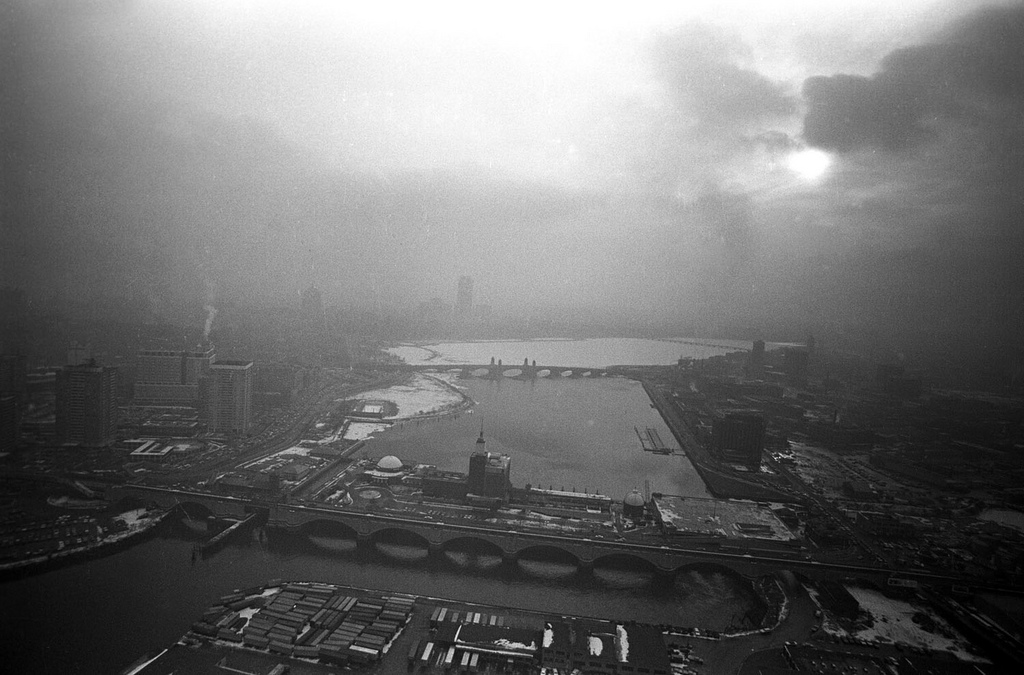
    In the early 1970’s, The Garden Club of the Back Bay teamed with The Greater Boston Citizens for Clean Air to host a meeting at Fisher College with three speakers of note: Dr. William A. Feder of the Department of Environmental Sciences at the University of Massachusetts, Dr. James J. Mackenzie of the Union of Concerned Scientists at Massachusetts Institute of Technology, and Paul P. Brountas, Chairman of the Metropolitan Boston Coalition for Cleaner Air. The three men spoke on Air Pollution – What the Citizen Can Do About It.

    The late Dr. Feder was an authority on acid rain, sewage sludge and pollution from cooling towers at power plants, and was a professor of plant pathology and environmental pollution. Dr. Jim MacKenzie, since 1986, was a Senior Associate in World Resources Institute’s Program in Climate, Energy and Pollution. He is author or co-author of numerous books and studies on transportation (including climate impacts, financial subsidies, electric cars, and impacts on US culture), climate change, energy security, acid rain and its impacts on trees, and global oil resources. Paul Brountas, an attorney, joined Hale and Dorr, the predecessor of WilmerHale, in 1960. He became a partner in 1968 and served as senior counsel to the firm from 2003 until his retirement in 2005. At Hale and Dorr, Mr. Brountas was chairman of the Corporate Department, chairman of the Executive Committee and chairman of the firm’s Strategic Planning Task Force.

    The Garden Club of the Back Bay continues to monitor environmental issues connected with our neighborhood, most recently our concern for the street trees suffering damage from the numerous gas leaks under our streets.

    smog

    Save

  • From the Archives – An Afternoon in Victorian Boston

    From the Archives – An Afternoon in Victorian Boston

    On a Saturday in May, 1980, The Garden Club of the Back Bay invited the public to An Afternoon in Victorian Boston, a tour of houses covering living styles from 1880 to 1980.  The first house on the itinerary was, of course, The Gibson House, a living Victorian Museum, with additional access to the garden of late Treasurer Irene Pitz.  Then participants were to walk to a contemporary home, roof garden and famous “Bagel Garden” of the SWA Group, Landscape Architects, followed by a peek at the first floor and conservatory of the Webster-Ames Mansion and tea on the Mall.  The proceeds were allocated to the restoration of the interior courtyard of the Boston Public Library.  The extraordinary price of this afternoon was $5.

    Idea Art

    Save

  • From the Archives – Front Yards Project and Snacking Students

    Throughout the early years of the Garden Club of the Back Bay, much effort was expended attempting to encourage building owners to beautify their front yards.  In conjunction with the Neighborhood Association of the Back Bay, Block Captains were appointed to contact owners and suggest solutions.  One exceptionally diplomatic letter was sent by Mrs. Hazel P. Chapin to a local school President and is excerpted below:

    “We are making an effort to contact all building owners or key personnel of the various schools in this area. It seems an unrelenting task to keep the Back Bay area an attractive place in which to reside, or for tourists to visit. We are appealing to you … to see if it wouldn’t be possible to motivate your students to take a collective pride in the outside appearance of their dormitories and classrooms …

    We realize it is difficult, with so many young people, with a propensity for snacking, not to become inundated with trash carelessly thrown about. However, if you could imbue them with an idea of some civic pride, I am sure the end result would not only be a more attractive block but also elevate the prestige of the school. “

    Today the need to take property owners to task is less urgent, since more front yards are meticulously maintained.  We do wonder if Mrs. Chapin ever received a reply, or if the students in question were ever asked to curtail their littering.  Image from www.upcity.com.

    Save

  • From the Archives: Blossomtime – Newbury Street

    Back in 1971, then Garden Club of the Back Bay President Myrna Esser, along with John N. Williams of The Neighborhood Association of the Back Bay, initiated Blossomtime: Newbury Street, a project to adorn 35 lamp posts on the entire stretch of Newbury Street with 70 baskets of petunias and vinca in hanging double planters. In preparation for this endeavor, she wrote to our area churches asking for their help in caring for the floral baskets.  She was especially concerned with watering from May through the fall. The baskets were to be hung “above vandalism height but reachable by a solid length of hose and sprayer attachment hooked into a 17 1/2 gallon tank on wheels.”

    Reverend Frederick Meek of Old South Church responded that after exploring several possibilities in person and by letter, he was unable to assume the responsibility, although he felt warmly toward the project.  The Reverend Charles W. Griffin of the First Baptist Church was also contacted but appears not to have responded.  Dr. Theodore Ferris of Trinity Church contributed financially to the project, but due to the fact that the planters would not be visible from the Church, was having trouble finding anyone willing to push around the tank.

    A college age girl, unidentified in our archives, was found to try the job, and arrangements were made to keep the tank in the garage at Bonwit Teller’s (now Restoration Hardware) on Newbury Street. Anyone with pictures of the baskets is encouraged to forward them to info@bostonflora.com.

    Save

  • From the Archives: The Trees of Beacon Street

    A letter went out to the residents of Beacon Street in 1910, from a citizens committee chaired by Mrs. F. T. Lord, from the Committee of the Metropolitan Improvement League (whose members included Frederick Law Olmsted,) and from the Secretary of the Massachusetts Forestry Association, Mr. Irving T. Guild. The letter is excerpted below:

    “A year ago a committee of residents of Beacon Street met with delegates of the Metropolitan Improvement League and the Massachusetts Forestry Association to consider the planting of a row of trees on either side of Beacon Street between Arlington Street and Massachusetts Avenue. A strong sentiment in favor of tree-planting had previously been shown by a house-to-house canvass by ladies of this committee. As a result of this meeting, Mr. Arthur A. Shurtleff, the well-known landscape architect and tree expert, was requested to make a complete study of the situation and to present a full report…

    The undersigned committee recommend that Mr. Shurtleff’s plan be adopted and the details of the undertaking be placed in his hands as architect. To do this will cost approximately $12,000, or an average of $34 per house, there being 352 houses between Arlington Street and Massachusetts Avenue.

    It is desirable that the work of preparing the pits be done during the summer months, when most of the residents will be away and when the work can be done more cheaply.  The planting should be done either in November or April, better in the latter month…

    Will you not contribute toward this well-considered, desirable, and permanent improvement of Beacon Street?  Cheques may be made payable and sent to R.G. Wadsworth, 323 Beacon Street.  If enough money is not raised, the cheques will be returned.  The committee wish to point out that as all the 352 houses between Arlington Street and Massachusetts Avenue are not occupied by permanent residents, it is hoped that those who are especially interested in the plan will not limit their contributions to any arbitrary sum. On the other hand, small contributions from any one interested will be very welcome.  Should more money than is necessary for the actual planting be obtained, this excess will be used for the future care of the trees.”

    This project was a successful early example of crowdfunding.  Thomas High, in his invaluable site www.backbayhouses.org, notes that Dr. Wadsworth was a physician who lived and maintained his office at 323 Beacon Street. Noted artist Polly Thayer Starr also resided there, and the building is now a lodging house. Picture below is from 1870, of a treeless Beacon Street looking west from Arlington Street.

    Save