Tag: Cambridge Common

  • Tuesday, November 8, 7:30 pm – Plasticity in Honey Bee Comb Arrangement in Response to Thermal Stress

    Welcome back to the first Cambridge Entomological Club meeting of the 2022-2023 academic year. We will be holding hybrid meetings to accommodate COVID-19 precautions and audience members from around the world. 

    Honey bees are a charismatic social insect species defined in part by their large familial colonies, production of honey, and intricate hives. Within their hives, honey bees use cells to store both developing brood and food. These stores are generally arranged with a dense central cluster of brood below large reserves of honey with a thin strip of pollen separating the two. It is believed that this characteristic pattern is maintained by self-organizing behavior – individuals following simple, localized rules to create large scale, emergent patterns. My PhD research has focused mainly on testing the limits of this emergent pattern. In this talk, Isaac Weinberg, Fifth Year PhD candidate, Tufts University Biology Department, will present data from three field experiments which observe the effect that chronic thermal stress has on the organization of honey bee colonies, and the implications these results have for honey bee health in a changing world.

    For those able to attend, we will have an informal dinner at 6:00 pm at Cambridge Common Restaurant with the speaker, followed by our formal meeting (7:30 – 9:00 pm) in the Gilbert Room of the Museum of Comparative Zoology (there will be signs to help direct). The meeting will begin with club announcements, followed by a 60-minute presentation by the invited speaker and Q&A. Membership is open to amateur and professional entomologists. 


  • Tuesday, April 8, 7:30 pm – The American Natural History Tradition

    Tuesday, April 8, 7:30 pm – The American Natural History Tradition

    The April meeting of the Cambridge Entomological Club will be held Tuesday, April 8 at 7:30 pm in Room 101 of the Museum of Comparative Zoology, Oxford Street, Cambridge. Professor William Leach will present a talk about the American Natural History Tradition.

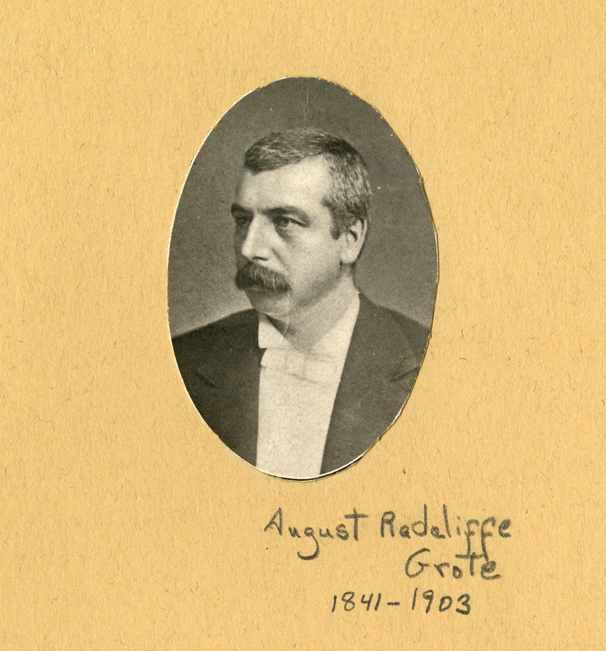
    If we want to understand why Americans started to collect and study butterflies in the 19th century, we must first understand the evolution of natural history itself. Originating in Europe and England, natural history acted as a language of interpretation and as a way of understanding nature that opened it up. It revealed to Americans what butterflies were all about and why they mattered and were worthy of study and reflection. By the 1870s a brilliant group of American butterfly men had emerged, their ideas forged within the heart of this tradition. They made a profound contribution to natural history, bringing to it a radical Darwinian analysis and a passion for life histories perhaps unrivaled by any of their contemporaries. This talk will examine the character of natural history in America between 1865 and 1885 and the way men such as William Henry Edwards, Benjamin Walsh, (former CEC president) Samuel Scudder, Herman Strecker, Augustus Radcliffe Grote (pictured below,) and William Doherty transformed and enriched it.

    The meeting is free and open to the public. Snacks will be provided and you are also welcome to join us at 6:00 PM for an informal pre-meeting dinner at the Cambridge Common.

    Augustus_Radcliffe_Grote_entomologist

  • Tuesday, October 8, 7:30 pm – Queens, Potential Queens, and Temporary Workers in a Tropical Paper Wasp Species

    The next meeting of the Cambridge Entomological Club  will be held on Tuesday, October 8 at 7:30 PM in in room 101 of the Museum of Comparative Zoology, 26 Oxford Street in Cambridge. Shantanu Shukla will present a talk entitled “Queens, potential queens, and temporary workers in a tropical paper wasp species”.

    Ropalidia marginata is a primitively eusocial wasp from southern and south-eastern Asia. Queens and the workers are morphologically similar, and reproductive castes are flexible. Queens are the sole egg layers in the colony, but workers retain the capacity to fully develop ovaries and become queens. What distinguishes this species is that the queen is not the dominant female, but is meek and docile. How then does the queen maintain her reproductive dominance? How does the colony regulate its maintenance and care? If workers are capable of becoming queens, why don’t they do so?  Dr. Shukla will demonstrate how he has used behavioral experiments to elucidate the mysteries of these complex and fascinating social insects.

    The meeting is free and open to the public. Snacks will be provided and you are also welcome to join us at 6:00 PM for an informal pre-meeting dinner at Cambridge Common. Image below from www.treknature.com.

    http://i1.treknature.com/photos/13984/paper-wasp.jpg