Tag: Cambridge University

  • Tuesday, May 28, 5:00 am – 6:30 am (but recorded) – Botanists and Botanical Art: Mary Delany

    The Gardens Trust presents a series of three talks on botanists and botanical art across three centuries, exploring people and illustrations that have defined, recorded and celebrated the world of plants in all their distinctiveness and intricacy. We start the series with exciting new research on previously unremarked botanical images on the paneling of a fine Jacobean house in Hampshire. In the second lecture we will examine the extraordinary set of almost a thousand paper collages of exotic plants produced by an 18th century woman of advanced years, before finishing with tales of a Victorian lady traveler who sought out rare plants in their native lands, not to collect – but to paint. Tickets for the three part series may be purchased through Eventbrite at https://www.eventbrite.co.uk/e/botanists-and-botanical-art-tickets-834657221217 Attendees will be sent a Zoom link 2 days (and again a few hours) prior to the start of the first talk (If you do not receive this link please contact us), and a link to the recorded session will be sent shortly after each session and will be available for 1 week.

    On May 28, we will explore the work of Mary Delany (1700 – 1788) and her ‘Paper Mosaicks’ with Twigs Way. Scandal, politics, botany, and art: this talk will explore the life of the ‘grotto nymph’ and creator of botanic paper collages, Mary Delany. Acclaimed by Sir Joseph Banks, personal friend of Queen Charlotte, and fellow ‘explorer’ of botanical wonders with the Duchess of Portland, Mary Delany embarked, aged 72, on a fabulous Flora of paper portrayals of exotic plants. This will be a heavily illustrated talk drawing on Mary Delany’s own words.

    Dr Twigs Way is a researcher, writer and speaker in garden history, fascinated by the past and intrigued by the role of flowers, gardens and landscape in art and culture of all kinds. Her research reflects that endless curiosity and her books on plants and gardens explore themes of symbolism and meaning, class and gender, art and literature. Currently (2024) delivering a series of talks for the Cambridge University Botanic Gardens on the overlap between garden design and textile fashion through the ages.

    Image: Passiflora laurifolia,Tulipa sylvestris and Rhododendron ponticum by Mary Delany © The Trustees of the British Museum, CC BY-NC-SA 4.0

  • Friday, December 1, 2:00 pm – 3:00 pm Eastern – Around the World in 80 Plants: A Botanical Journey of Beauty and Science, Myth and Mayhem, Online

    The American Horticultural Society invites you to hear Jonathan Drori, author and board member, Cambridge University Botanic Garden, in a virtual presentation on Friday, December 1 at 2 pm Eastern time.

    In his follow-up to Around the World in 80 Trees, bestselling author Jonathan Drori takes another gloriously illustrated trip across the globe, bringing to life the science of plants by revealing how their worlds are intricately entwined with our own history, culture and folklore. From the seemingly familiar tomato and dandelion to the eerie mandrake and Spanish ‘moss’ of Louisiana, his stories are full of surprises. Some plants have a troubling past, while others have ignited human creativity or enabled civilizations to flourish.

    Jonathan Drori lives in London, England. He is on the Board of Cambridge University Botanic Garden and the Eden Project, and was formerly Trustee of the Royal Botanic Gardens, Kew. As a documentary film maker for the BBC he was responsible for more than 50 prime-time science shows and documentaries.  His books are bestsellers in more than twenty languages worldwide, available from Amazon (Around the World in 80 Trees and Around the World in 80 Plants) and all good indie bookstores. $10 for AHS members, $15 for nonmembers. Register at https://ahsgardening.org/lifelong-learning/around-the-world-in-80-plants/

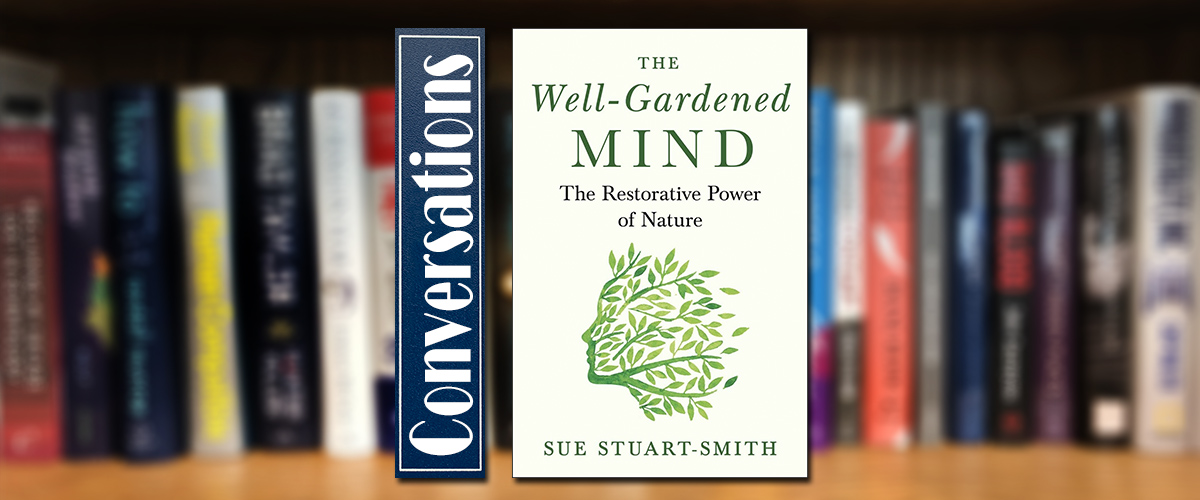
  • Friday, March 3, 6:00 pm – 7:00 pm – Sue Stuart Smith: The Well-Gardened Mind

    Friday, March 3, 6:00 pm – 7:00 pm – Sue Stuart Smith: The Well-Gardened Mind

    Distinguished psychiatrist and avid gardener Sue Stuart-Smith believes our minds and our gardens interact in ways that can sustain our innermost selves. Her beautifully written UK bestseller, The Well-Gardened Mind, offers inspiring perspectives on the power of gardening to change people’s lives. For Stuart-Smith, a garden is much more than a beloved physical space. It is a mental space where you can hear your thoughts immersed in the primal awareness not only of nature’s beauty, but the eternal cycle of the seasons. Informed by literature, neuroscience and her experiences as therapist and gardener, she celebrates the joys of gardening, but also the life-affirming benefits of tending plants-physical, psychological and metaphorical.

    Before practicing as a psychiatrist and psychotherapist, Sue Stuart-Smith received her degree in English literature at Cambridge. Over the past 30 years, she has worked with her husband, leading UK garden designer Tom Stuart-Smith, on their wonderful Barn Garden in Hertfordshire.

    This Garden Conservancy lecture will take place on March 3 from 6 – 7 at the deCordova Sculpture Park and Museum in Lincoln, Massachusetts. To register, visit https://www.gardenconservancy.org/education/2023-speaker-series. The Spring 2023 National Speaking Tour is in partnership with Perfect Earth Project

  • Wednesday, May 9, 7:00 pm – 8:30 pm – The Philosophical Breakfast Club and the Invention of the “Scientist”

    In 1812, four remarkable men met at Cambridge University: Charles Babbage, John Herschel, Richard Jones and William Whewell. Recognizing that they shared a love of science (as well as good food and drink), they began to meet on Sunday mornings to talk about the state of science in Britain and the world at large. Inspired by the great seventeenth-century scientific reformer and political figure Francis Bacon, the Philosophical Breakfast Club plotted to bring about a scientific revolution—one which privileged an evidence-based, inductive method of discovery, and one which asserted the need for science to serve the public good. In her book, The Philosophical Breakfast Club, Laura Snyder follows the intertwined lives and works of these men over the next 60 years, and shows that by the end of their lives they had succeeded, even beyond their wildest dreams, in bringing about a scientific revolution. She will speak about one aspect of the revolution they wrought: the shift from the amateur natural philosopher to the professional scientist.  Dr. Snyder, Associate Professor of Philosophy at St. John’s University, will speak at the Hunnewell Building of the Arnold Arboretum on Wednesday, May 9, from 7 – 8:30 pm.  Register online at www.my.arboretum.harvard.edu.  Fee: Free for Arboretum members; $15 nonmembers.