Tag: City University of New York

  • Native Plant Trust Announces Yard Futures Project

    Native Plant Trust, the nation’s first plant conservation organization and the only one solely focused on New England’s native plants, has partnered with the renowned Woodwell Climate Research Center to share ground-breaking research about how American homeowners in six major metropolitan areas currently shape their yards and what can be done to create spaces that work better for both people and the environment. This research and best practices that come out of the Yard Futures Project are now available to the public in brief articles on the Native Plant Trust website, www.NativePlantTrust.org, which will be regularly updated.

    The Yard Futures Project is a collaboration of scientists affiliated with institutions from across the U.S., including Woodwell Climate Research Center, Duke University, City University of New York, University of Massachusetts, Johns Hopkins University, University of Minnesota, Arizona State University, U.S. Forest Service, University of Utah, University of Delaware, Portland State University, Davidson College, Clark University, Masaryk University, University of Vermont and Virginia Tech. The research focuses on homeowners and their yards in the metropolitan areas of Boston, Baltimore, Los Angeles, Miami, Minneapolis-St. Paul, and Phoenix and includes on-site field studies, extensive surveys, and interviews.

    The project studies the impact of homeowners’ choices and examines not only how homeowners shape their yards, but also importantly why they make particular choices about lawns, gardens, and maintenance regimes. The project measures how yards influence attributes of residential ecosystems such as plant and insect biodiversity, microclimates, soil carbon and the potential for nitrogen runoff.

    The team is publishing most of the project findings in peer-reviewed scientific journals and other professional outlets; the brief articles at www.NativePlantTrust.org present the results in an accessible, engaging way that can immediately be put to use by the public. Christopher Neill, Ph.D., Senior Scientist at the Woodwell Climate Research Center, is editorial director and lead author for the series.

    “Urban and suburban yards now cover huge areas across the US. And more and more people care deeply about making their yards better habitat for wildlife and better providers of some of the services more natural areas provide, like carbon storage and shade that lowers air temperatures,” said Chris Neill. “This project aims to take what we’ve learned from studying yards across the country and put it in a form that homeowners can both understand and translate into things that they can do in their own yards.”

    The project receives funding from the National Science Foundation’s Macro Systems Biology Program, which is investigating the causes and consequences of large-scale ecological patterns.

  • Wednesday, September 11, 7:00 pm – The Chickadee’s Guide to Gardening: Why Native Plants Matter to Songbirds and the Food They Eat Webinar

    Residential landscapes and gardening practices can have a positive (or negative) impact on wildlife. In this September 11 Ecological Landscape Alliance webinar, Dr. Desiree Narango will speak about her research studying plant and wildlife interactions. The talk will focus on her recent work comparing the contributions of native and non-native plants to food webs by studying breeding birds in Washington, D.C. suburban yards. In addition, she will talk about the relationships between plants and insects, why insects matter to birds, and steps you can take in your landscape designs or in your own yards to improve habitat for wildlife. Dr. Narango will also share resources to find more information about nature-friendly gardening and participating in community-driven science.

    Dr. Desiree Narango is a Postdoctoral Researcher at City University of New York and a visiting researcher at University of Massachusetts Amherst. Her research interests include urban/suburban ecology, plant-animal interactions, and community-driven science (to name a few). Desiree has a PhD in Entomology and Wildlife Ecology from University of Delaware, a M.S. in Natural Resources from The Ohio State University, a B.S. in Environmental Biology from SUNY: ESF and over 15 years’ experience studying wildlife. She’s also an active birder and gardener who really enjoys getting others excited about the natural world in their own yards. Free for ELA members, $10 for nonmembers. Register at www.ecolandcaping.org.

  • Friday, April 6, 6:45 pm – New England Lichens: Leveraging Past Riches to Understanding the Present and Future

    The New England Botanical Club Distinguished Speaker, Dr. James Lendemer, will speak on Friday, April 6 at 6:45 pm in the Haller Lecture Hall, Room 102, Geological Museum, 24 Oxfore Street in Cambridge. Dr. Lendemer is Assistant Curator, Lichenology, Institute of Systematic Botany, New York Botanical Garden, and Assistant Professor, Department of Biology Graduate Center, City University of New York. His topic is New England Lichens: Leveraging Past Riches to Understanding the Present and Future. Dr. Lendemer says: “As the staff lichenologist and an assistant curator in the Institute of Systematic Botany, I spearhead a diverse program of research and education focused on lichens—symbiotic fungi that are often considered to be the equivalent of corals on land. I oversee the curation of the lichen collection at New York Botanical Garden, the largest such collection in the western hemisphere, and one that serves scientists and land managers worldwide by providing access to unique high quality data. My research focuses on understanding the biodiversity of lichens in North America, while simultaneously working with collaborative partners to develop and implement conservation strategies that will safeguard those species for future generations.” Free and open to the public. For more information visit www.rhodora.org.

  • Tuesday, November 29, 12:00 noon – 1:00 pm – Museums Without Walls: The Sculpture Collection of the Boston Common, The Public Garden, and the Commonwealth Avenue Mall

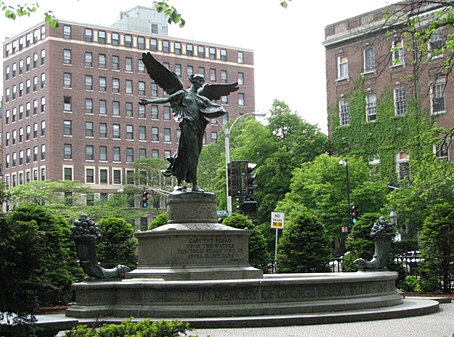
    Greater Boston boasts a number of art museums, each of which, naturally, has galleries for the display of art. These galleries are constructed of walls and floors and ceilings. Even more naturally, however, the city has another art museum, whose floor is the earth, whose ceiling is the sky, and whose walls are the trees. This special museum has three major galleries: the Boston Common, the Boston Public Garden, and the Commonwealth Avenue Mall. These galleries display an impressive collection of public sculpture that is free and accessible 24/7, 365 days a year. In this free public illustrated lecture, David Dearinger, PhD will give a brief overview of Boston’s “museum without walls” and the role that sculpture plays in its history and aesthetics. The talk will take place at the Boston Athenaeum, 10 1/2 Beacon Street,  on Tuesday, November 29, and registration is not required. For complete details visit http://www.bostonathenaeum.org/events/4142/museums-without-walls-sculpture-collection-boston-common-public-garden-and-commonwealth

    David B. Dearinger is Director of Exhibitions and Susan Morse Hilles Senior Curator of Paintings & Sculpture at the Boston Athenæum. He holds a PhD in art history from the Graduate Center of the City University of New York with a specialization in nineteenth century American art. He became a member of the curatorial staff at the National Academy of Design in New York in 1985, where he served as Chief Curator from 1995 until 2004, when he joined the Boston Athenæum. He has taught art history at a number of institutions, including the State University of New York’s Fashion Institute of Technology, where he taught for over twenty years. He has lectured and published widely in the field of American art and has curated and organized a number of exhibitions in New York and Boston.

  • Saturday, April 12, 10:00 am – 12:00 noon – Northeast Wildflowers to Brighten Your Spring Garden

    Learn about the importance of native wildflowers and how to bring them into the garden setting, on Saturday, April 12 from 10 – noon at the Berkshire Botanical Garden, at a talk and book signing with author Carol Gracie. Wildflowers brighten the New England woodlands in spring and are more than just a delight for the eye and a lift for the winter-weary spirit. Each has a role in the environment and often has interesting interactions with pollinators and seed dispersers. Learn about the fascinating life histories of some favorite spring wildflowers. Topics include adaptations for early blooming, medicinal and other uses, the origin of wildflower names, pollination and seed dispersal. A book sale and signing of Carol’s beautiful newly published Spring Wildflowers of the Northeast: A Natural History will follow the talk.

    Carol Gracie is a naturalist and photographer with a degree in plant studies from Lehman College of the City University of New York. She is retired from The New York Botanical Garden, where she headed the Children’s Education Program and the Foreign Tour program and taught in the Continuing Education Program. In 2006 she co-authored (with Steve Clemants) Wildflowers in the Field and Forest: A Field Guide to the Northeastern United States. Her latest book, Spring Wildflowers of the Northeast: A Natural History, was published in March of 2012.

    $25 for BBG members, $30 for non-members.  Sign up at www.berkshirebotanical.org or call 413-298-3926, x 15.

    http://press.princeton.edu/images/k9668.gif