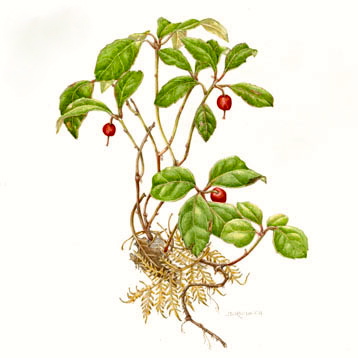
The florilegium was commissioned by Mary Somerset, the first Duchess of Beaufort between 1703 and 1707. Mary Beaufort was a passionate gardener and her gardens at Badminton and Beaufort House, London, were recorded in several well-known views published in Knyff and Kip’s Britannia Illustrata. Interested in plants and gardens from an early age, after her second marriage to Henry Somerset, first Duke of Beaufort, in 1657, she oversaw the planting of the extensive gardens seen in Knyff and Kip’s engraved views. But it was after her husband died when the Duchess was in her seventies, that she threw herself even more fully into the collecting and rearing of plants from all over the world.
In order to record permanently her horticultural successes, the duchess commissioned a florilegium from a Dutch artist, Everhard Kick, who had previously worked for her friend, Sir Hans Sloane in London. Kick, whose work was continued by Daniel Frankcom, a member of the duchess’s household, developed an idiosyncratic style in which he showed the roots of plants growing beneath the ground. The online Gardens Trust talk on February 27 at 2 pm Eastern will discuss Mary Beaufort as a gardener and highlight some of the contents of her remarkable flower book. Attendees will be sent a Zoom link 2 days prior to the start of the talk, and a link to the recorded session (available for 1 week) will be sent shortly afterwards. Register through Eventbrite HERE.
Art historian and curator Henrietta McBurney will present a series of four online lectures beginning February 6 through the Gardens Trust.
These talks discuss several gardens created during the seventeenth century, and the first decade of the eighteenth century, which were recorded in watercolour in books of fruits and flowers (florilegia). In each of these books, insects and occasionally animals are shown in different ways, together with the fruits and flowers. In a fourth group of drawings insects are given as prominent a role as the botanical specimens themselves.
The compiler of the earliest of these spectacular albums, the so-called ‘Tradescant’s Orchard’, is unknown; the manuscript dates from the second and third decades of the seventeenth century and is one of the treasures of the Bodleian Library. A decade or so later the gardener, horticulturist and gentleman artist, Alexander Marshal, began his florilegium, continuing to add to it until his death in 1682. Now housed in the Royal Library at Windsor, this contains portraits of flowers made from a number of gardens in and around London. During the first decade of the eighteenth century the first Duchess of Beaufort commissioned two volumes of watercolours on vellum recording the exotic plants she was growing in her stoves (hothouses) at Badminton House. This florilegium is still housed in the library at Badminton House. Another pioneering Plantswoman and collector, Maria Sibylla Merian, recorded in her own watercolours the exotic plants and insects she saw on her travels to the Dutch colony of Suriname during the last two years of the seventeenth century. These dramatic images, published in her Metamorphosis Insectorum Surinamensium, were to influence the compilers of the Duchess of Beaufort’s florilegium.
Each of the four talks will be devoted to one of these remarkable groups of watercolors and their compilers. Attendees will be sent a Zoom link 2 days prior to the start of the talk. A link to the recorded session (available for 1 week) will be sent shortly afterwards. This ticket costs £16 for the course of 4 sessions or you may purchase a ticket for individual sessions, costing £5. Purchases are through Eventbrite.
Week one focuses on Alexander Marshal. Alexander Marshal (c. 1620-1682), a ‘Gentleman of independent fortune’, was renowned during his lifetime as ‘one of the greatest Florists’ or plantsmen. A key figure in the closely entwined garden circles of late seventeenth-century London, his exquisite florilegium was described by John Evelyn as ‘a curious book of flowers in miniature’. It contains portraits of flowers arranged seasonally, made from plants not only in his own gardens but that of the royal gardener, John Tradescant the younger, and Henry Compton, Bishop of London. Including watercolours of the newest imports of plants from the New World and the Near East, as well as native wild flowers, the florilegium is a unique survival in English art of the seventeenth century.
Marshal’s florilegium has been part of the Royal Collection at Windsor Castle since 1820. The talk will place it in the context of Continental florilegia and English gardens of his time, and will highlight some of its remarkable contents, including the animal and insect studies Marshal included alongside his enticing portraits of flowers. Henrietta McBurney MVO, FLS, FSA, is an art curator and art historian. She worked as curator in the Print Room of the Royal Library, Windsor, for nearly 20 years. Subsequently she was keeper of fine and decorative art at Eton College, and curator of collections at the Garrick Club and Newnham College, Cambridge; she has since worked free-lance as a curator for Cambridge colleges. She has a particular interest in the intersection of art and science and has recently published Illuminating Natural History. The Art and Science of Mark Catesby(Paul Mellon Centre/Yale, June 2021). Other publications include studies on the 17th-century Florilegium of Alexander Marshal and Birds, Other Animals and Natural Curiosities, the natural history drawings for Cassiano dal Pozzo’s Paper Museum.
The Friends of Wellesley Botanic Gardens invite you to head outside with Carol Govan and Sarah Roche for three days, July 15 – 17, to observe botany in action in the College’s meadows and then record the flowering plants that you see using pencil and pen sketches and dry brush watercolor. The class will be held from 9:30 – 3:30 and the registration fee is $225 for Friends of Wellesley Botanic Gardens and $275 for non-members. Call 781-283-3094, or email wcbgfriends@wellesley.edu.