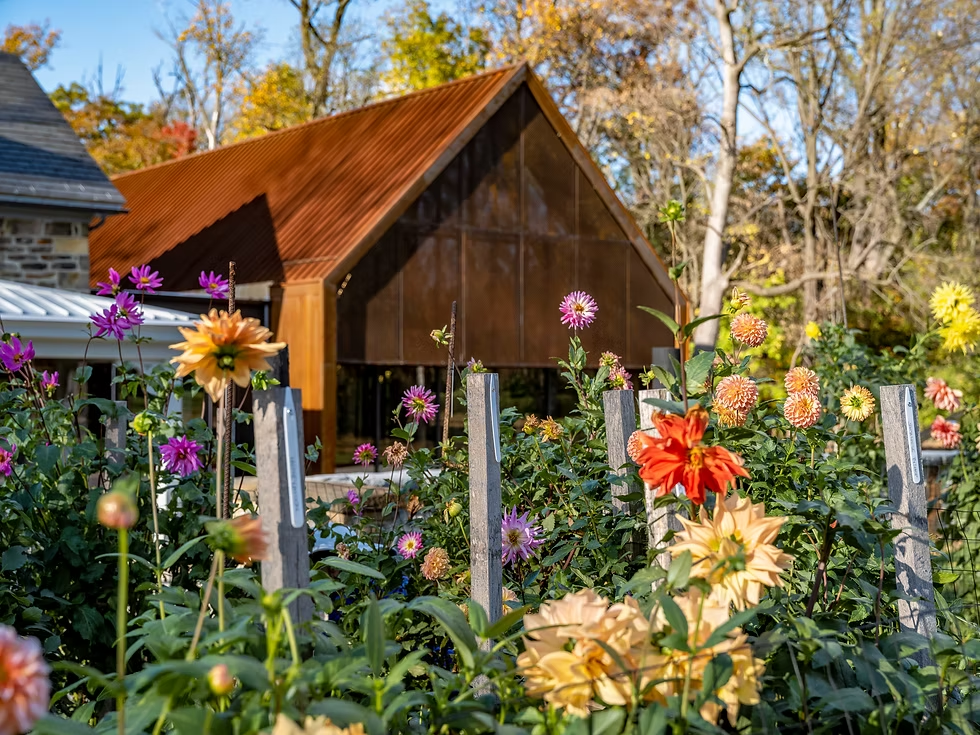
The Kitchen Garden is dedicated to one of gardening’s oldest yet often overlooked forms of gardening. For over 12,000 years, humankind has domesticated and cultivated edible plants, yet the kitchen garden has long stood in the shadow of its ornamental counterparts. Recently, growing one’s own produce has seen a surge in popularity, propelled by renewed interest in organic food, self-sufficiency, and sustainable living, bringing this historic, practical, and increasingly influential garden type back into the spotlight. Toby Musgrave’s Garden Conservancy online presentation on September 22 at 2 pm Eastern will celebrate the art of the kitchen garden and provide attendees with inspiration and ideas for what to grow in gardens of all shapes and sizes. He will highlight the work of such renowned contemporary garden designers as Patrice Taravella of Babylonstoren in South Africa, Arne Maynard of Gordon Castle in the UK, Charles Dowding of Homeacres in the UK, and Charles Stick of Sleepy Cat Farm in the United States. He is an international authority on gardens and plant history, on which he has been widely published. His books for Phaidon include The Gardens: Elements and Styles and Green Escapes. He is also a garden designer, has presented on numerous television programs and is faculty lecturer at the Danish Institute for Study Abroad. $5 Garden Conservancy members, $15 non members. Register at https://www.gardenconservancy.org/events/web26-the-kitchen-garden-webinar-only
SPECIAL OFFER: If you’d like to purchase the book, The Kitchen Garden by Toby Musgrave, you will be provided with complimentary admission to the webinar. Price includes book, free shipping, and webinar admission. To take advantage of this offer, register here. $50.
In her book A Moment in Time: Designing a Country Garden, the award-winning landscape designer Kathryn Herman presents a four-season exploration of her own home, the historic Pepperidge Farm estate in Connecticut, which she has tended and developed lovingly for over 30 years. Her garden is a favorite destination in the Garden Conservancy Open Days program. Herman is well-known for creating poetic gardens that are contemporary yet inspired by quintessential English gardens— perfect for today’s lifestyles and a lovely way to update and complement a historic house. Here, she breaks down her design process by touring her garden in sections and adding thematic essays full of a career’s worth of tips and tricks so all home gardeners can adapt elements of her approach themselves. Join an online discussion and gain insights into elements such as form and structure, color, ornament, incorporating history, creating meadows, cultivating an orchard, planning a perennial garden, making a garden appealing to wildlife, and planning for seasonality.
Kathryn Herman is founding Principal of her Connecticut-based landscape architecture firm. Her work encompasses a wide range of distinguished residential estates and select commercial projects across the United States, Europe, the Caribbean, and the Middle East. She has received numerous honors including American Society of Landscape Architects awards, Palladio Awards for excellence in classical design, and the Arthur Ross Award. Her projects have been featured in publications such as Veranda, Architectural Digest, House & Garden UK, and The Wall Street Journal.
Horticulture and art have a long and storied history, often co-mingling and inspiring each other to exciting ends. In this near-daylong program in Providence—America’s “Renaissance City”—join Garden Conservancy President & CEO James Brayton Hall on a visit to the house and garden of acclaimed artist Andrew Raftery in the morning, followed by lunch and a visit to the RISD Museum in the afternoon. James, who began his career in Providence, eventually serving as Deputy Director of the RISD Museum, will discuss the rich interchange between Andrew’s garden and artistic practice. At the RISD Museum, one of America’s foremost university art museums, this discussion will expand to consider a rich array of design objects that draw on horticultural themes in a private session with museum curators Emily Banas and Kate Irvin. This program is currently sold out but join the waitlist at https://www.gardenconservancy.org/events/gm26-art-design-in-providence
The Garden Conservancy will sponsor three separate sessions of an Open Day at Windy Hill in Hancock, New Hampshire on August 15. Registration for each session (10 – 12, 12 – 2, and 2 – 4) is separate. Please check the website when signing up to be sure you have chosen the correct time.
This landscape garden sits on a rocky, windy ridge with expansive views of New Hampshire mountains continuing south to Massachusetts. It is the work of the owners and Bill Noble, teaming with Lindsay Johnson, Kyle McCabe and Barrett Proctor.
The garden is dictated by the harsh and imposing landscape. Boulders provide structure and echo the mountains. The garden is also a sanctuary for many species of fireflies, amphibians and other insects and wildlife. The garden includes an entry drive through restored native woodland, pollinator beds, a meadow lawn, a Tree Garden (oaks pruned to frame the hills) and a Rockery planted with native shrubs and ground covers.
To the south, an approximately mile-long stroll garden passes through the colorful, insect-filled energy of a wild flower meadow, to the tranquil light and shadow of deep forest, over a board walk through a stumpery (a garden of stumps, snags and fallen trees embedded in the forest), past woodland clearings and back to the house.
Another approximately half-mile stroll garden passes through another meadow to a grove of pruned birch and around a pond. The garden is four years old and is very much a work in progress. $10 for nonmembers.
Join the Garden Conservancy on July 30 at 2 pm for a virtual roundtable exploring the evolving state of garden media. Our distinguished panelists and moderator will examine the forces shaping today’s information ecosystem and share practical guidance on finding trusted, useful, and inspiring resources for your gardening questions.
Where can gardeners turn for reliable news and information today? What seems like a simple question has anything but a simple answer. Gardeners are more information-hungry than ever as our aesthetic sensibilities broaden, and the sources we rely on continually shift and evolve. Our questions, often driven by climate and ecology, are increasingly specific to region and context, even as many local newspapers retire longtime garden columns or disappear altogether. At the same time, other legacy media are adapting and even thriving with new niche magazines and an expanding roster of gardening titles from major book publishers. Then there’s digital sleuthing! AI-enhanced search results appear wonderfully authoritative but have been shown to hallucinate answers. And online plant databases (though invaluable) can be unwieldy, opaque, or intimidating. Blogs may be waning in popularity as Substack and social media rise, but the explosion of voices makes it harder than ever to distinguish sound advice from sponsored content. In short, garden media has reached an inflection point—and it’s time to take stock. $5 for Conservancy members, $15 for non-members. Register at https://www.gardenconservancy.org/events/web26-from-columns-to-clicks
Moderator MARGARET ROACH is a longtime garden writer—first for Newsday newspaper, then for Martha Stewart Living (where she became the company’s EVP/Editorial Director) and the last six growing seasons for The New York Times. She also creates a website, podcast, and weekly newsletter called “A Way to Garden,” the title of her 1989 book that was reissued in 2019 in an all-new edition. Margaret has written several other books, including in 2013 The Backyard Parables. Her public-radio podcast, called A Way to Garden, is in its sixteenth year.
Panelists include:
KEVIN CLIFF (aka @theplantpapi)
ROCHELLE GREAYER
REBECCA McMACKIN
STEPHEN ORR
You will receive the webinar link directly from Zoom. A recording of this webinar will be sent to all registrants a few days after the event. We encourage you to register, even if you cannot attend the live webinar.
In the heart of European and American cities lies an overlooked yet vibrant space for resilience, ingenuity and magic: the garden. Part history, part reportage, part manifesto, Tiny Gardens Everywhere: The Past, Present, and Future of the Self-Provisioning City follows the 300-year history of urban gardening—from feudal England to the Paris Commune, to Berlin’s green shantytowns, to contemporary Amsterdam, Chicago, and beyond.
Throughout, acclaimed MIT historian Kate Brown weaves in her own gardening experience, exploring the political and the practical while painting a picture of the necessity of self-provisioning in an increasingly chaotic world. Ever since wage labor in cities replaced self-provisioning in the countryside, gardeners have reclaimed lost commons on urban lots. They composted garbage into topsoil, creating the most fertile agriculture in recorded human history, without the use of fossil fuels.
The ecological diversity they fostered made room for human difference and built prosperity, too: In Nazi Berlin, working class gardeners harbored dissidents and Jews; in Washington, DC, Black southern migrants built communities around gardens and orchards, the produce funding homeownership. The Soviet superpower survived so long only because of its urban gardens. In Tiny Gardens Everywhere, Brown creates a mesmerizing hybrid of past and present, archive and experience, showing how down-to-earth gardeners, through resourcefulness, intuition, and inherited methods, can reap abundant, local, diverse and organic harvests while fostering mutual aid, community, and political engagement.
This York, Maine garden, which has been evolving over the last 75 years, surrounds and complements a Georgian-style stone house. There are formal and informal borders, a vegetable garden, orchard, and collections of various flowering trees and shrubs. Apples and pears are espaliered on the house and along the walls of the formal front garden. Water features include a pond in the woodland garden, a farm pond with rustic bridge, and the Atlantic Ocean. This treasure is protected by a sculpted arborvitae hedge on the northwest, a mature stand of hickory on the northeast, and an extensive screen of old lilacs on the southeast.
Ongoing projects include expanding the collection of magnolias and rhododendrons, a new shrub border in the old orchard, a woodland walk, a summerhouse with views to the pond and the sea, and the constant refreshing of the front walled garden. The Garden Conservancy is sponsoring this garden as part of its 2026 Open Days schedule. To register, visit www.gardenconservancy.org
Wild Knoll Foundation Garden in York, Maine, is a living artwork planted on the footprint of the former home of writer May Sarton, who kept the tending of her gardens central to her creative life, as chronicled in The House by the Sea.
Artist Carly Glovinski created a new garden based on its original architectural drawings, with each “room” featuring a unique color scheme. The property where the garden grows is home to nationally renowned artist residency, Surf Point.
On June 27 at 10 am, Carly will share the story of creating and tending the garden, and how it has become a site for connection and creative incubator.
This Digging Deeper Host reports the following Terrain Notes about the garden: We will gather at Wild Knoll, on the mowed lawn area in front of stone terrace and garden. This program is presented by the Garden Conservancy in partnership with Surf Point. $30 for members of sponsoring organizations, $40 for nonmembers. Register at www.gardenconservancy.org
Four beautiful gardens in the Mondadnock Region of New Hampshire will be on display Sunday, June 7 from 10 – 4 courtesy of The Garden Conservancy. Preregistration is required. Admission to each garden is $5 for Conservancy members, $10 for nonmembers.
The May Place gardens of Bill and Eileen Elliott are in Hancock, New Hampshire. Two compulsive plant collectors have been making gardens on a wooded hillside clearing for forty-five years. They continue to do all of the planning, landscaping, planting and maintenance themselves.
Gardening offers ample challenges and satisfaction as the garden continues to expand, change, die back, thrive, disappoint, and exhilarate. Within the green wall of mature woodland is a two-acre clearing which contains a mix of trees, shrubs, perennials, biennials, annuals, herbs and vegetables. (Picture below courtesy of Yankee Magazine)
A 200-yard path through the woods leads to shade and container gardens near the house.
Also in Hancock is Skatutakee Farm. The gardens surround Hancock’s first house, built in 1778 by the town clerk, Jonathan Bennett. The farmhouse plantings are informal and blend into surrounding fields and woods.
On each side of the old front door are beds reminiscent of Colonial gardens, flanked by plantings of old roses and nepeta. Behind the 1970 kitchen wing is a 48-foot-long
koi pond designed by landscape architect Diane McGuire and planted with lotuses, irises, and water lilies.
McGuire also laid out the perennial bed and woodland border planted with witch hazel, azaleas, snakeroot, and Rodgersia.
The AIA-award-winning screened porch was designed by Dan Scully. A pair of 200-year-old granite Korean rams graze on the back lawn.
Walking beyond the borders, one comes to a bog garden surrounded by marsh marigolds, skunk cabbage, and sedges. A trail of cardinal flowers brightens the wetland beyond. In the field below the terraced potager are two beds planted heavily in pollinators for late arrival of Monarch butterflies.
In Peterborough is the garden of Betsy and Michael Gordon. This small garden in the village was designed by a plantsman to be an extension of the house. The house and garden are situated on a hill and the garden is terraced on three levels. The upper level was designed to be enjoyed from the street. The middle level is laid out formally using yew hedges and a century-old granite wall foundation to create a garden room. The lowest level, an informal woodland garden, has both eastern North American and eastern Asian shade-loving plants. The garden was planted with a mixture of unusual trees, shrubs, perennials, grasses, annuals, and bulbs. Plants were selected primarily for interesting form, foliage, and texture. The garden is chronicled on Instagram @thegardenerseye. Register at https://www.gardenconservancy.org/garden-directory/open-days/garden-of-michael-betsy-gordon
Continuing on to Dublin is the Japanese Garden. The Japanese garden project began after the owner had worked for over 15 years to build a small traditional Japanese house on property in Dublin. The garden and pond were added so that visitors could experience that same quiet feeling outside the house as they did inside.
Throughout history, gardeners have been compelled to put pen to paper to capture the beauty, seasonal changes and quiet philosophy of their plots. Claire Masset’s new book, Garden Voices: A Year of Gardeners’ Writing, brings together some of the best of these musings—through letters, diary entries, and articles—in a unique anthology organized around the calendar year. Readers are transported across time and place to enjoy rare horticultural glimpses from both world-famous gardeners and lesser-known—though no less inspiring—garden writers.
On May 19 at 2 pm Eastern, Claire Masset will explore a selection of these voices, from artists Claude Monet, Camille Pissarro and Van Gogh to writer-gardeners Celia Thaxter, Derek Jarman and Vita Sackville-West. Accompanied by carefully selected paintings and photographs, the talk will offer insights into their lives, thoughts, and achievements, revealing gardens not only as places of beauty, but as powerful sources of artistic and personal expression. $5 for Garden Conservancy members, $15 for nonmembers. Register at https://www.gardenconservancy.org/events/web26-writing-the-garden