Tag: Massachusetts Historical Society

  • Tuesday, April 12, 5:15 pm – 6:30 pm – Pipe Dreams: The Pursuit of Desalination and the Promise of a Water-Abundant Future in the 1950s and 1960s, Online

    Driven by the strong conviction that water resources needed to be managed, controlled, and used in a rational manner, fears about not being able to meet present and future water needs triggered and justified the proliferation of large water infrastructure projects in the post-WWII period—and also the pursuit of desalination. Its potential as a new, untapped source of fresh water carried promises of modernization and development, and especially appealed to governments looking to develop, diversify, and decentralize sources of supply. By uncovering how several countries and international organizations imagined the potential of desalination, and tried to jumpstart its widespread adoption, shows how the story of desalination adds new layers to our understanding of the development era. This Massachusetts Historical Society lecture with Elizabeth Hameeteman of Boston University will take place Tuesday, April 12 at 5:15 pm, online. Register to attend online

    The Environmental History Seminar invites you to join the conversation. Seminars bring together a diverse group of scholars and interested members of the public to workshop a pre-circulated paperLearn more.

    Please note, this is an online event hosted on the video conference platform, Zoom. Registrants will receive a confirmation message with attendance information.

  • Wednesday, January 26, 5:30 pm – 6:30 pm – Lost on the Freedom Trail: The National Park Service and Urban Renewal in Postwar Boston, Online

    Boston National Historical Park is one of America’s most popular heritage destinations, drawing in millions of visitors annually. Tourists flock there to see the site of the Boston Massacre, to relive Paul Revere’s midnight ride, and to board Old Ironsides—all of these bound together by the iconic Freedom Trail, which traces the city’s revolutionary saga. Seth C. Bruggeman of Temple University discusses the Freedom Trail’s role for tourism, how it was devised to lure affluent white Americans into downtown revival schemes, its success hinging on a narrow vision of the city’s history run through with old stories about heroic white men. When Congress pressured the National Park Service to create this historical park for the nation’s bicentennial celebration in 1976, these ideas seeped into its organizational logic, precluding the possibility that history might prevail over gentrification and profit. Professor Bruggeman will present his book on January 26 online through the Massachusetts Historical Society, and then be joined by experts with knowledge of the Freedom Trail today and in the past. Free. Register to attend online

  • Tuesday, January 25, 5:15 pm – 6:30 pm – Earthquakes in New England, 1600 – 1800: Extraordinary Natural Events and Timekeeping Practices in Early America, Online

    Katrin Kleeman of the German Maritime Museum at the Leibniz Institute for Maritime History, will speak with the Massachusetts Historical Society on January 25 at 5:15 online, with comments by Lukas Rieppel of Brown University.

    New England is more seismically active than most would expect. Several notable earthquakes shook the northeast in the past, such as in 1638, 1663, 1727, 1755, or 1783, to name but a few. In early America, earthquakes were rare enough, however, to be perceived as unusual events that contemporaries remarked upon them in their diaries, almanacks, sermons, and newspapers. Although clocks were still rare in the seventeenth and eighteenth centuries, diarists often gave a precise time when an earthquake struck—which varied, often, drastically from observer to observer. This allows for questions on how and how reliably time was kept.

    The Environmental History Seminar invites you to join the conversation. Seminars bring together a diverse group of scholars and interested members of the public to workshop a pre-circulated paperLearn more.

    Please note, this is an online event hosted on the video conference platform, Zoom. Registrants will receive a confirmation message with attendance information. Register to attend online

  • Thursday, December 16, 5:15 pm – 6:30 pm – Local Food Before Locavores: Growing Vegetables in the Boston Market Garden District, 1870 – 1930, Live and Online

    The Boston market garden district was a national leader in vegetable production from 1870 to 1930.  Suburban market gardeners’ practices both countered and anticipated broader trends in the US food system.  For example, intercropping  (though long-known) stood well outside the US agro-ecological mainstream. Boston growers also developed the modern forcing house, an engineered greenhouse environment dependent on fossil fuels, irrigation, and commodified insect pollinators.  Year-round lettuce from these houses helped prepare the way for consumers to embrace a de-seasonalized, nationalized vegetable supply.  This agro-environmental episode shows how the history of local food complicates our narratives about US food system modernization.

    The Massachusetts Historical Society will sponsor this December 16 lecture by Sally McMurry, Pennsylvania State University, with comments by Andrew Robichaud of Boston University. The free event begins at 5:15 pm.

    The Environmental History Seminar invites you to join the conversation. Seminars bring together a diverse group of scholars and interested members of the public to workshop a pre-circulated paperLearn more.

    Please note, this is a hybrid event which may be attended either in person (register HERE) at the MHS or virtually on the video conference platform, Zoom (register HERE) Registrants will receive a confirmation message with attendance information.

  • Thursday, November 4, 5:15 pm – 6:30 pm – The “Science” of Dry-Farming: The Emergence of a Concept in Global Perspective, Live or Online

    This Massachusetts Historical Society presentation on November 4 by Elizabeth Williams, University of Massachusetts, Lowell, examines the emergence of dry farming as a new “scientific” agricultural method in the late 19th and early 20th centuries within broader global circulations of agricultural knowledge. Connecting the dry farming knowledge of American agronomists to that of French colonial officials working in North Africa who were themselves indebted to centuries of knowledge about dry farming techniques developed by farmers working in rainfed lands around the Mediterranean basin, it sheds light on the politics of expertise involved in the production of this “science.”

    The Environmental History Seminar invites you to join the conversation. Seminars bring together a diverse group of scholars and interested members of the public to workshop a pre-circulated paperLearn more.

    Please note, this is a hybrid event which may be attended either in person at the MHS or virtually on the video conference platform, Zoom. Registrants will receive a confirmation message with attendance information. Register for the in person event HERE or online HERE

  • Tuesday, November 17, 6:30 pm – 7:30 pm – Virtual Making History Gala

    The Massachusetts Historical Society will hold its annual Making History Gala online on November 17 from 6:30 – 7:30 pm. The benefit will feature Jon Meacham in conversation with Emily Rooney.

    Jon Meacham is a Pulitzer Prize-winning presidential historian, contributing writer to The New York Times Book Review, and contributing editor at TIME. His #1 New York Times bestseller, The Soul of America: The Battle for Our Better Angels, looks at tumultuous periods in American history when presidents and ordinary citizens came together to rebuild a civic trust.

    Emily is the creator and former host of Greater Boston. Since 1997, Emily has brought her journalistic credentials and deep knowledge of media, politics and culture to the GBH audience and has earned numerous awards, including the National Press Club’s prestigious Arthur Rowse Award for Press Criticism, a series of New England Emmy Awards, and Associated Press recognition for Best News/Talk Show. Before coming to GBH, Emily was director of political coverage and special events at Fox Network in New York from 1994 to 1997. Prior to that, she was executive producer of ABC World News Tonight with Peter Jennings. Emily also worked at WCVB-­TV in Boston from 1979 to 1993, where she served as news director for three years and as assistant news director before that.

    Honorary Chairs of the event are Governor Charlie Baker and First Lady Lauren Baker, Edward C. and Elizabeth B. Johnson, Henry Lee, CJ and Neil Musante, and Mayor Martin J. Walsh. $500 – register at www.masshist.org.

  • Monday, November 9, 5:30 pm – 6:30 pm – A Treasury of Massachusetts House Museums and Local History Organizations, Part I: What is a House Museum?

    A Massachusetts Historical Society online program with William Hosley of Terra Firma Northeast will take place Monday, November 9, from 5:30 – 6:30 Eastern time.

    Massachusetts has more house museums and historical organizations than most states twice our size. In recent years there’s been a national conversation about the sustainability of house museums. Our presenter argues that this widespread, mostly small class of museums vary tremendously. While many of our community-based historical organizations preserve and present their collections in historic houses, a house museum is something different. We will hear from three outstanding ones that are grappling with the usual challenges of audience engagement, preservation and interpretation.

    Please note, this is a free online event held on the video conference platform, Zoom. Registrants will receive an email with links to join the program. Register at www.masshist.org.

  • Friday, June 26, 2:00 pm – 3:00 pm – Virtual Tour of Jackson Homestead Museum in Newton

    Friday, June 26, 2:00 pm – 3:00 pm – Virtual Tour of Jackson Homestead Museum in Newton

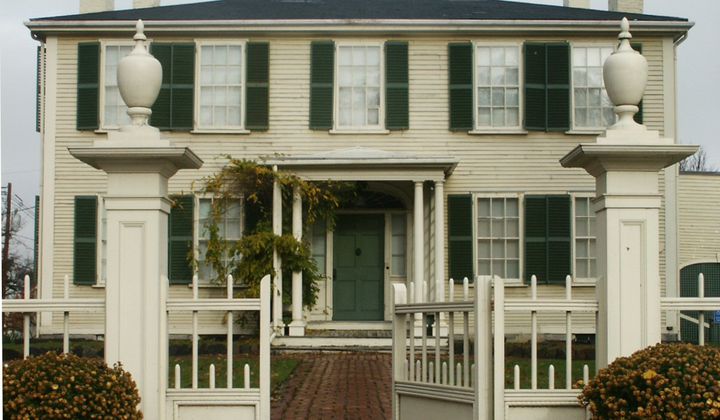
    The Jackson Homestead and Museum is one of two historic house museums that comprise Historic Newton and is now home to exhibitions on the history of food, farming, and family life; slavery and anti-slavery; and notable people and events in Newton, Mass.

    Join us and Clara Silverstein for an online tour of the federal-style house built in 1809 for Timothy Jackson and his family.

    This free tour, from 2 p.m. to 3 p.m. on June 26. will focus specifically on the complex legacy of slavery and abolitionism at the homestead, including its history as a stop on the Underground Railroad.

    Register at the Massachusetts Historical Society website, http://masshist.org to receive an email with links and instructions on how to join the program.

  • Thursday, May 14, 4:30 pm – – Gibson House Museum Virtual Benefit

    The Gibson House Museum is sponsoring on online raffle whose proceeds will go a long way towards replacing lost support form the Museum’s closure and cancellation of its annual benefit due to the corona virus crisis. As you may recall, NABB was to be honored at the cancelled benefit.
     
    There will be an Instagram live-streamed raffle drawing on Thursday, May 14, 2020 at 4:30 pm. Please visit www.thegibsonhouse.org for details and to purchase tickets. Tickets may be purchased through Tuesday, May 12. The drawing will be live streamed on the museum’s Instagram page: @gibsonhousemuseum.


  • Tuesday, March 10, 5:15 pm – 7:30 pm – The Metabolism of Military Forces in the War of Independence: Environmental Contexts and Consequences

    The Massachusetts Historical Society presents an Environmental History Seminar on Tuesday, March 10 at 5:15 at 1154 Boylston Street in Boston on The Metabolism of Military Forces in the War of Independence: Environmental Contexts and Consequences. David Hsiung of Juniata College will speak, with comment by James Rice of Tufts University. In order to function during the War of Independence, armies and navies needed multiple sources of energy—food, firewood, work animals (which also needed food), ammunition, and more. How did specific natural environments, both proximate and distant, fuel those military metabolisms? How did such actions affect those environments in the decades and centuries that followed? This presentation is the seed of a book proposal that, when watered by your feedback, will germinate come summertime. Free, but registration requested at www.masshist.org.