Tag: Museum Of Comparative Zoology

  • Tuesday, October 13, 7:30 pm – Small Carpenter Bees: What Insect Societies Tell Us

    The first Cambridge Entomological Club meeting of the 2015-16 year will be held on Tuesday October 13 at 07:30 PM. Please join them in in room 101 of the Museum of Comparative Zoology, as Sandra Rehan will present a talk entitled “Comparative biology of Ceratina small carpenter bees: What early insect societies can tell us about the evolution of sociality”.

    The small carpenter bees, genus Ceratina, offer important insights into the early stages of social group formation. Small carpenter bees provide a unique opportunity to study the evolution and maintenance of social behavior in a group benefitting from detailed life history studies and a well-established phylogeny. Ceratina are globally-distributed and species range from solitary to complex societies; solitary species are typically found in temperate environments and social groups are recurrent in tropical regions. Sandra’s data highlights the importance of molecular phylogeny and historical biogeography for understanding the relative roles of phylogenetic inertia and regional ecology on the evolution of social behavior. Moreover, maternal care is a key precursor for the evolution of eusociality. Maternal investment is often determined, in part, by the quality and quantity of food provided to the offspring. Such maternal manipulation of nutrients, during development in particular, can influence the activation of hormones, nutrient storage, and social interactions of offspring once development is complete. The small carpenter bee, Ceratina calcarata, is native to New England and this species is of special interest because of its prolonged maternal care and mothers who produce a special class of small daughters that help raise their siblings. Sandra examines nutritional, developmental and behavioral variation among offspring to determine the role of maternal manipulation and social environment on offspring care and worker behavior in incipient insect societies.

    The meeting is free and open to the public. Snacks will be provided and you are also welcome to join them at 5:45 PM for an informal pre-meeting dinner at West Side Lounge Restaurant.

  • Tuesday, May 12, 7:30 pm – Ant Plant Mutualisms

    May’s meeting of the Cambridge Entomological Club will be held Tuesday May 12th at 7:30 PM in room 101 of the Museum of Comparative Zoology, Oxford Street, Cambridge. John Boyle of Harvard University and President of Cambridge Entomological Club will be presenting the 2015 Presidential Address and telling us about Ant Plant Mutualisms. Please note this is the last meeting until October.

    Mutualistic symbioses between ants and plants are a common feature of the tropics. Hundreds of different plants throughout the world have evolved cavities in which ant colonies can live, and even special organs that provide food for the ants. In return, the ants protect their trees against the encroachment of other plants and against herbivores–even herbivores as large as giraffe and elephant!

    In John’s talk for the CEC, he will present some of the diversity of ant-plant mutualisms, and also discuss his own research into one particular ant-plant, the whistling-thorn acacia, Vachellia drepanolobium. This ant-plant is unusual in that four different ant species compete for space on the tree, and all four ant species appear to cheat on the tree in different ways: some prune off its flowers, others tend sap-sucking scale insects, and so on. He will discuss his research on the colony-level underpinnings of this wide diversity in ant behavior.The meeting is free and open to the public. Snacks will be provided and you are also welcome to join us at 6:00 pm for an informal pre-meeting dinner at Cambridge Common.  Image from www.baraza.wildlifedirect.org.

  • Thursday, April 23, 6:00 pm – Islands: Natural Laboratories of Evolution

    Tahiti, Bermuda, Madeira, Bali. Everyone loves islands, but no one loves them more than an evolutionary biologist. From the dwarf elephants of Crete to the carnivorous caterpillars of Hawaii and the snaggly-fingered aye-aye of Madagascar, islands present a cornucopia of biodiversity. Darwin drew much of his inspiration from island stopovers on his fabled Beagle voyage, as did Alfred Russel Wallace on his own perambulations through the East Indies. Ever since Darwin and Wallace jointly proposed their theory of evolution by natural selection, biologists have returned to islands to gain fresh insights. Jonathan Losos, Monique and Philip Lehner Professor for the Study of Latin America, Department of Organismic and Evolutionary Biology and Curator in Herpetology, Museum of Comparative Zoology, Harvard University, will discuss the relevance of islands to our understanding of evolution and its processes on Thursday, April 23 at 6 pm at the Geological Lecture Hall, 24 Oxford Street. Free and open to the public. Free parking is also available at the 52 Oxford Street Garage.

  • Tuesday, March 10, 7:30 pm – The Reintroduction of the American Burying Beetle to Nantucket

    March’s Cambridge Entomological Club meeting will be held Tuesday, March 10th at 7:30 PM in room 101 of the Museum of Comparative Zoology, Oxford Street in Cambridge. Andrew Mckenna-Foster (pictured below,) the Director of Natural Sciences at the Maria Mitchell Association, will be telling us about The Reintroduction of the American Burying Beetle to Nantucket Island.

    The federally endangered American burying beetle, Nicrophorus americanus (Coleoptera: Silphidae) is the largest of North America’s carrion beetles. Its historical range covered 35 states in the eastern temperate areas of North America, but today, populations remain in only eight states and it is possibly one of the rarest beetle species in the United States. The range of ABBs on the east coast is particularly limited, only surviving naturally on Block Island, RI. In 1994, 48 N. americanus were released on Nantucket Island, MA in a large collaborative effort to build a second east coast population. “As we observed how this new population was settling in on the island, we have adapted our monitoring and reintroduction methodology to efficiently boost the number of wild beetles. After a peak in capture numbers in 2011 (212 beetles), we entered a phase of testing whether the species can survive on the island with little to no assistance. I will talk about what we have learned concerning dispersal, winter survival, reproduction, and ultimately, the probable fate of this population.”

    The meeting is free and open to the public. Snacks will be provided and you are also welcome to join us at 6:00 pm for an informal pre-meeting dinner at Cambridge Common.

  • Tuesday, February 10, 7:30 pm – Genomic Insights into Multi-species Interactions

    February’s meeting of the Cambridge Entomological Society will be held Tuesday the 10th at 07:30 PM in room 101 of the Museum of Comparative Zoology, 26 Oxford Street in Cambridge. Dr. Tanya Renner is visiting from the University of Arizona and will tell us about Genomic Insights into Multi-species Interactions: Molecular Evolution, Form, and Function.

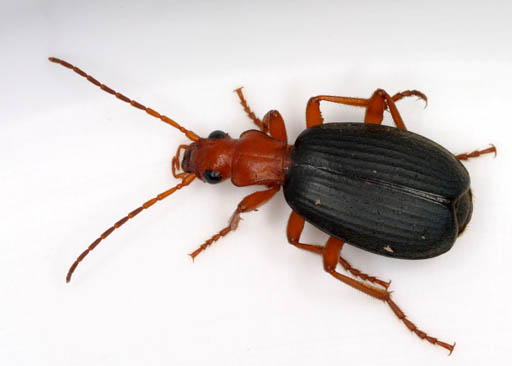
    From carnivorous plant enzymes that digest insect prey, to bombardier beetles (below)  that have obligate associations with ants and spray defensive compounds up to 100 degrees C, evolution has played an integral role in the co-option of preexisting genes, driving the emergence of new functions that define the traits we see today. We will explore these processes in the context of natural history, examining the evolution of a plant lineage’s ability to digest insect exoskeletons, the chemosensory system in paussine ant nest beetles, and emerging data on the enzyme precursors that are responsible for the bombardier beetle’s explosive blast.

    Dr. Renner describes her research: “The goal of my research is to examine the patterns and processes of evolution and functional diversification at the molecular level. I am particularly interested in how multi-species interactions shape biodiversity at the microevolutionary scale and influence form and function.”  You can find her lab at San Diego State University at http://www.tanyarenner.org/

    The meeting is free and open to the public. Snacks will be provided and you are also welcome to join us at 6:00 pm for an informal pre-meeting dinner at Cambridge Common.

  • Tuesday, January 13, 7:30 pm – The Bee: A Natural History

    The January meeting of the Cambridge Entomological Club will take place Tuesday, January 13 at 7:30 pm in Room 101 of the Museum of Comparative Zoology, 26 Oxford Street, Cambridge.  The speaker will be Noah Wilson-Rich, the founder of The Best Bees Company and author of The Bee: A Natural History.  The meeting is free and open to the public.  Snacks will be provided, and you are welcome to join the group at 6 pm for an informal pre-meeting dinner at Cambridge Common.  For more information email Shayla Salzman at shaylasalzman@FAS.harvard.edu.

  • Tuesday, May 13, 7:30 pm – Weevil Diversity: Beyond the 60,000 Names

    The Annual Meeting of the Cambridge Entomological Club will be held Tuesday, May 13, beginning at 7:30 pm in Room 101 of the Museum of Comparative Zoology, Oxford Street, Cambridge.  Bruno de Medeiros will give the traditional President’s address, this year entitled Weevil Diversity: Beyond the 60,000 Names.

    Many people know about horned scarab beetles fighting for females, or insect predators such a praying mantises that can be cannibals. What is less well-known is that similar stories can be found among the seemingly uninteresting plant-feeding beetles known as weevils. Weevils stand out as a very diverse group in terms of number of species – in fact, they are the most diverse family of animals. However, they are much more than a bunch of names, and weevil natural history can also be very interesting and sometimes even surprising. In this talk Bruno will share some stories that he found while doing research on palm-associated weevils during the last few years, and also the adventures that he went through while chasing them in Brazil.

    The meeting is free and open to the public. Snacks will be provided and you are also welcome to join us at 6:00 PM for an informal pre-meeting dinner at the Cambridge Common.

  • Tuesday, April 8, 7:30 pm – The American Natural History Tradition

    Tuesday, April 8, 7:30 pm – The American Natural History Tradition

    The April meeting of the Cambridge Entomological Club will be held Tuesday, April 8 at 7:30 pm in Room 101 of the Museum of Comparative Zoology, Oxford Street, Cambridge. Professor William Leach will present a talk about the American Natural History Tradition.

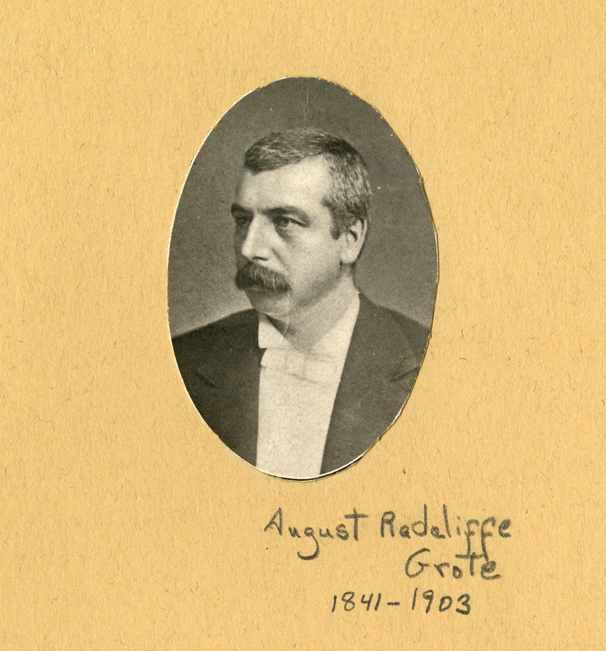
    If we want to understand why Americans started to collect and study butterflies in the 19th century, we must first understand the evolution of natural history itself. Originating in Europe and England, natural history acted as a language of interpretation and as a way of understanding nature that opened it up. It revealed to Americans what butterflies were all about and why they mattered and were worthy of study and reflection. By the 1870s a brilliant group of American butterfly men had emerged, their ideas forged within the heart of this tradition. They made a profound contribution to natural history, bringing to it a radical Darwinian analysis and a passion for life histories perhaps unrivaled by any of their contemporaries. This talk will examine the character of natural history in America between 1865 and 1885 and the way men such as William Henry Edwards, Benjamin Walsh, (former CEC president) Samuel Scudder, Herman Strecker, Augustus Radcliffe Grote (pictured below,) and William Doherty transformed and enriched it.

    The meeting is free and open to the public. Snacks will be provided and you are also welcome to join us at 6:00 PM for an informal pre-meeting dinner at the Cambridge Common.

    Augustus_Radcliffe_Grote_entomologist

  • Wednesday, April 2, 6:00 pm – From Darwin to DNA: The Genetic Basis of Animal Behavior

    How do certain animals, such as wild mice, evolve their most critical survival traits, including skin coloration, body shape, and the ability to dig elaborate tunnels in order to hide from predators? How fast can successive generations acquire visible traits, and how do animal genes and behavior interact? Evolutionary geneticist Hopi Hoekstra, Professor of Zoology and Curator of Mammals at the Museum of Comparative Zoology, Harvard University, and colleagues have combined extensive field research with the latest techniques in DNA analysis to unlock one of biology’s most elusive secrets: the genes that control behavior. She will speak on Wednesday, April 2, beginning at 6 pm at the Geological Lecture Hall of the Harvard Museum of Natural History, 24 Oxford Street, Cambridge. The Evolution Matters Lecture Series is supported by a generous gift from Drs. Herman and Joan Suit. Free and open to the public. Free event parking in the 52 Oxford Street Garage.

    https://www.mcb.harvard.edu/mcb_files/media/editor_uploads/2013/05/2013_hoekstra_hhmi.jpg

  • Tuesday, March 11, 7:30 pm – Food of the Future: Insects!

    The March meeting of the Cambridge Entomological Club will be held Tuesday, March 11 in room 101 of the Museum of Comparative Zoology, 24 Oxford Street, Cambridge. Laura D’Asaro and Rose Wang will present a talk about the Food of the Future: Insects!

    Laura D’Asaro and Rose Wang are 2013 Harvard College graduates and co-founders at Six Foods. Six Foods makes delicious foods from insects, a healthier and more sustainable protein source. They will talk about the state of entomophagy in the world and how introducing insects into the Western diet can help solve some of the world’s biggest problems.

    They will also bring some of their insect foods for us to sample. Bug Appétit! Visit their website at sixfoods.com for more information.

    The meeting is free and open to the public. Snacks will be provided and you are also welcome to join us at 6:00 PM for an informal (non-entomophagous) pre-meeting dinner at the Cambridge Common.

    http://dsi.sva.edu//srv/htdocs/wp-content/uploads/2013/12/Meryl_Food.jpg