Tag: Smithsonian

  • Tuesday, November 9, 6:45 pm – 8:00 pm – Truffle Hound: Following the World’s Most Seductive Scent, Online

    The elusive, complex, and baffling scent of the truffle—it’s been compared to garlic, cheese, earth, sex, and gasoline, and more—sent James Beard-award-winning author Rowan Jacobsen down a rabbit hole. He emerged into a mysterious secretive world of black-market deals, obsessive chefs, and some very determined dogs.

    Drawing on his new book, Truffle Hound: On the Trail of the World’s Most Seductive Scent, with Dreamers, Schemers, and Some Extraordinary Dogs, Jacobsen explores the industry of truffle hunting, which extends from Italy to eastern Europe, and Oregon to Quebec. Before they were appropriated by “the high priests of haute cuisine and the captains of commerce,” Jacobsen writes, “truffles were the thing from the forest”  searched for mostly by local peasants.

    Why has this fungus become a culinary luxury fetching up to $3,000 a pound? Hear Jacobsen’s colorful account of his quest for an answer, and the memorable truffle hunters he met along the way, on November 9 at 6:45 with Smithsonian Associates, online.

    Copies of Truffle Hound (Bloomsbury) are available for purchase.

    Book Sale Information

    • Purchase your copy of Truffle Hound by Rowan Jacobson here.
    • SPECIAL NOTE: Politics and Prose is offering a 10% discount to Smithsonian Associates ticket-holders. To claim your discount, enter the code SPECIAL10 (no space between letters and numbers) in the “Coupon discount” section on Politics and Prose’s check-out page.

    Registration information

    $20 Smithsonian members, $25 nonmembers. Register HERE

  • Wednesdays, October 13 – November 17, 12:00 pm – 1:30 pm – The Art of Floral Design, Online

    Join floral artist Arrin Sutliff and Smithsonian Associates online for six Wednesday sessions, October 13 – November 17, to explore the spectrum of floral design. Sourcing (with a focus on sustainability), making the most of seasonal flowers, creating centerpieces, wiring techniques, bouquet-making, and photographing your work are all among the practical areas covered. 

    Based in DC, Arrin Sutliff creates site-specific and time-based work using plants, flowers, and digital media. Her work spans from immersive installs to single stem expressions. Arrin is the owner of Tint Floral which focuses on using local flowers for weddings, art, and collaborations.

    Designed for students of all levels, beginners can gain a full understanding of what floral design entails, while more experienced students can continue to advance their skills as they create their own work. A supply list of tools and flowers is available for participants who would like a hands-on experience, but all are welcome to relax and follow along as Sutliff creates some beautiful designs step by step.

    Note: This streamed program will not be recorded. $135 for Smithsonian members, $165 for nonmembers. Register HERE.

  • Fridays, October 8 – October 22, 10:00 am – 11:30 am – The Potomac: A National and Cultural History, Online

    The Potomac River is one of the most storied in North America, with a rich natural and cultural history reflected throughout its nearly 400 miles of waterways that extend from the Appalachian highlands of West Virginia to the Chesapeake Bay. Environmental historian Hayden Mathews brings that heritage to life in a three-part Smithsonian Associates online series that focuses on how the Potomac has shaped the lives of the those who settled along its banks from their arrival after the last Ice Age to the present day and how those lives, in turn, have had an impact on the river. He offers a chance to gain a fresh appreciation for the riches of this lovely valley, the river that carved it, and the people that populated its shores. 

    The Potomac flows through rocks that hold more than a billion years of Earth’s history and encompasses many different ecological areas that are home to an extraordinary diversity of plant and animal species. Mathews’ first program examines the natural, ecological, and geological forces that defined the character of the land we see today, covering continental collisions, glaciations, and species lost and gained.

    He shifts to cultural history in subsequent programs that highlight some of the most notable aspects of the 15,000 years that humans have inhabited this area. Mathews moves from the lifeways of the Paleoindians and First Nations peoples to the stories of slaves seeking freedom, inventors, smugglers, fishermen, floods, and first ladies, painting a colorful portrait of Mid-Atlantic history and some of the memorable men, women, and events that played roles in that saga. 

    Register at www.smithsonianassociates.org. $65 for Smithsonian members, $75 for nonmembers. If you register multiple individuals, you will be asked to supply individual names and email addresses so they can receive a Zoom link email. Please note that if there is a change in program schedule or a cancellation, we will notify you via email, and it will be your responsibility to notify other registrants in your group. Unless otherwise noted, registration for streaming programs typically closes two hours prior to the start time on the date of the program. Once registered, patrons should receive an automatic email confirmation from CustomerService@SmithsonianAssociates.org. Separate Zoom link information will be emailed closer to the date of the program. If you do not receive your Zoom link information 24 hours prior to the start of the program, please email Customer Service for assistance.

  • Friday, October 1, 7:00 pm – 8:15 pm – Autumn in Washington: Arboreal Splendors, Online

    Springtime in Washington is legendary, but what about that other fabulous season, fall? Join Smithsonian Associates and author and tree expert Melanie Choukas-Bradley on a virtual tour through autumn in the capital and see why its arboreal splendors should be as celebrated as spring’s cherry blossoms.

    Washington’s beautiful fall lasts for several months, with a steady procession of seasonal colors starting in September and continuing beyond Thanksgiving and into December. Get primed for the coming season with a preview of botanical highlights in store, learn about the trees, flowers, and fruits in the city’s storied landscapes, and you’ll be ready to get out and enjoy this fall more than ever. The Zoom illustrated lecture is $25 for Smithsonian members, $30 for nonmembers, and you may register at https://smithsonianassociates.org/ticketing/tickets/autumn-in-washington-arboreal-splendors

  • Wednesday, July 31, 7:30 pm – Offshore Entomology: Bees, Moths, and the Hidden Diversity of Vineyard Pollinators

    Visit The Polly Hill Arboretum in West Tisbury on July 31 at 7:30 for a free lecture by Paul Goldstein, research entomologist with the USDA Systematic Entomology Laboratory in Washington, DC, where he is curator in the Lepidoptera (moth) collection at the Smithsonian. This presentation will showcase some of the highlights of 30 years of work devoted to the Island’s insects, and the unique diversity of its native bees, moths, and other pollinators. Featuring vivid images of these insects and their Island habitats, Dr. Goldstein will describe the fascinating biology of some of our most unusual, colorful, and beneficial insect residents, and their importance to understanding our environment.

  • Wednesday, January 9, 6:30 pm – 8:30 pm – The Power of Public Monuments and Why They Matter

    The Committee to Renew the Shaw 54th Memorial cordially invites you to join them for a community conversation on The Power of Public Monuments and Why They Matter, featuring a dynamic panel of speakers moderated by Beverly Morgan-Welch, Smithsonian National Museum of African American History and Culture. The event takes place Wednesday, January 9 from 6:30 – 8:30 at the Tremont Temple Baptist Church, 88 Tremont Street in Boston. Emcee Karen Holmes Ward of WCVB Boston welcomes DeRay McKessen, civil rights activist, Renee Ater, American public art historian, and F. Sheffield Hale of the Atlanta History Center. The event is in part sponsored by The Salah Foundation and The Friends of the Public Garden.  Free, but registration required by clicking HERE.

    Image result for shaw 54th regiment memorial

  • Volunteer Opportunity – Counting on Ginkgos for Climate Change

    Ginkgo trees evolved before the dinosaurs, survived three mass extinctions, and one species is still living today. The Smithsonian Institution’s Museum of Natural History staff are researching how the cells of leaves on ginkgos have changed over time, and whether we can use them to learn about the ancient atmosphere of the Earth. We want to create a record of how the atmosphere has changed through time by calculating the ratio of two different types of leaf cell (stomatal and epidermal) for many leaves, from the present and the geological past. It is important for us to understand what effect climate change might have on life on our planet in the long term.

    One way we can understand the effect of climate change is to look at the geological past – millions of years ago – and the fossil record, to see what happened to organisms during periods of time in Earth history when there were similar changes in the atmosphere and climate. If we want to build an accurate picture of these past changes, we need to know what the atmosphere was like back then.

    Our planet’s atmosphere is composed of many different gasses, one of which is carbon-dioxide (CO2). Through extensive research we now know that CO2 concentration in the atmosphere has a very important influence on Earth’s climate. There are several ways researchers try to reconstruct past climates; we call these climate proxies. One proxy for CO2 concentration comes from plants, and is known as stomatal index. This is a measure of the number of gas-exchange holes on the surface of a leaf, relative to the number of normal cells. Count cells of modern and fossil leaves and help them track climate change over millions of years. You will count oval-shaped stomata in highly magnified images of both fossilized and living ginkgo leaves. Learn how to do it at https://www.zooniverse.org/projects/laurasoul/fossil-atmospheres

  • Saturday, April 15, 12:30 pm – 1:30 pm – Thoreau and the Language of Trees

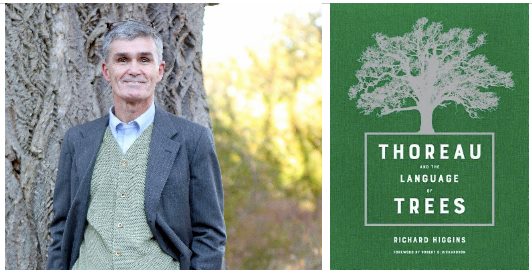
    Richard Higgins will speak at Tower Hill Botanic Garden on Saturday, April 15 beginning at 12:30 on his new book, Thoreau and the Language of Trees. Free with admission. pre-registration requested at www.towerhillbg.org. Trees were central to Henry David Thoreau’s creativity as a writer, his work as a naturalist, his thought, and his inner life. His portraits of them were so perfect, it was as if he could see the sap flowing beneath their bark. When Thoreau wrote that the poet loves the pine tree as his own shadow in the air, he was speaking about himself. In short, he spoke their language.

    In this original book, Richard Higgins explores Thoreau’s deep connections to trees: his keen perception of them, the joy they gave him, the poetry he saw in them, his philosophical view of them, and how they fed his soul. His lively essays show that trees were a thread connecting all parts of Thoreau’s being-heart, mind, and spirit. Included are one hundred excerpts from Thoreau’s writings about trees, paired with over sixty of the author’s photographs. Thoreau’s words are as vivid now as they were in 1890, when an English naturalist wrote that he was unusually able to “to preserve the flashing forest colors in unfading light.” Thoreau and the Language of Trees shows that Thoreau, with uncanny foresight, believed trees were essential to the preservation of the world.

    Richard Higgins is a former longtime staff writer for the Boston Globe whose writing has appeared in numerous publications, including the New York Times, Atlantic Monthly, Christian Century, and Smithsonian. He lives in Concord, Massachusetts.

  • Friday, April 7, 6:45 pm – Native Orchids and Mycorrhiza: Ecologically Complex Interactions

    The New England Botanical Club will host its 2017 Distinguished Speaker Dr. Dennis Whigham, Senior Botanist, Smithsonian Environmental Research Center and North American Orchid Conservation Center, on Friday April 7, beginning at 6:45 pm. He will speak on Native Orchids and Mycorrhiza: Ecologically Complex Interactions.

    The Orchidaceae is a species-rich family of flowering plants with more than 30,000 known taxa globally. Like most terrestrial plants, orchid species interact with mycorrhizal fungi, but unlike most plants, there is little evidence that the interactions are mutualistic. Most research indicates that orchids manage the plant-fungal interactions and they consume the fungi as sources of carbon and other resources. Dependency on fungi has evolved in a number of orchid lineages to a complete dependency on fungi resulting in many species being completely mycoheterotrophic. Understanding orchid-fungal interactions is not only interesting, but it is key to orchid conservation because all orchids have, at least, one life history stage that is completely depending on fungi.

    Dennis will focus on native orchids of the U.S. and Canada to describe the ecological challenges that remain obstacles to a more complete understanding of orchid-fungal interactions. He will link issues related to orchid ecology to a Smithsonian-initiated continental-scale effort to use an ecological model to conserve native orchids through a collaborative effort that is being developed by the North American Orchid Conservation Center (NAOCC). Dennis will describe how members of the New England Botanical Club have already provided important support for NAOCC and how members can become engaged in the only effort to assure the survival of an entire plant family at a continental scale. Meetings at Harvard University are held in Haller Lecture Hall (Room 102), Geological Museum, 24 Oxford St., Cambridge, MA 02138 (door to right of Harvard Museum of Natural History entrance).  Free and open to the public.  Image from www.wabash.edu.

  • Thursday, November 10, 7:00 pm – Gardner Museum Landscape Lecture: Julie Bargmann

    Julie Bargmann is a leader in designing and building regenerative and environmentally appropriate landscapes. She founded D.I.R.T. studio in 1992. Highly regarded for her versatility and hands-on approach (she likes to get her hands dirty), Bargmann’s work hews to themes of sustainability, economy, community engagement, respect for site histories, and above all a love of the landscape. For Vintondale Reclamation Park in rural Pennsylvania, she collaborated to create a large-scale natural filtration system for a waterway polluted by acid-mine drainage. The project earned D.I.R.T. the 2001 National Design Award from the Smithsonian’s Cooper-Hewitt Museum. Landscape Lectures begin at 7 pm in Calderwood Hall at the Isabella Stewart Gardner Museum. Lectures include Museum admission and require a ticket; tickets can be reserved online, in person at the door, or by phone: 617 278 5156. Museum admission: adults $15, seniors $12, students $5, free for members. This Thursday, November 10 event is sponsored by an anonymous donor. Landscape and Horticulture public programs are supported by the Barbara E. Millen and Markley H. Boyer Endowment Fund. This program is supported in part by the Massachusetts Cultural Council, which receives support from the State of Massachusetts and the National Endowment for the Arts.

    Save