Month: April 2017

  • Thursday, July 20 – Saturday, August 12, 9:00 am – 8:00 pm (weekdays) – Plant Anatomy: Development, Function, and Evolution

    This two-week summer short course, July 20 – August 12, will be taught by experts from around the world as an intense lecture, laboratory, and living collections learning experience. The course will be based at the Weld Hill Research Building at the Arnold Arboretum, which offers a state-of-the-art microscopy laboratory for teaching and sits amid the 15,000+ living specimens of more than 2,200 species at the Arnold Arboretum.

    With the opportunity to bring molecular genetic and genomic tools to almost any clade of plants, it is essential to understand the biology of the organisms in question. A key challenge will be to link comparative developmental genetics to existing bodies of knowledge; notably the over two hundred year legacy of plant anatomy. This integration is critical as the phylogenetic, structural, and ecological breadth of plant taxa open to study expands, and potential questions become increasingly sophisticated. This course will provide a working knowledge of tools and concepts that are central to understanding the anatomical basis for structural and functional diversity.

    Instructors:

    Pieter Baas (Naturalis Biodiversity Center)
    Pamela Diggle (University of Connecticut)
    William (Ned) Friedman (Harvard University)
    Peter Gasson (Royal Botanic Gardens, Kew)
    Cynthia Jones (University of Connecticut)
    Elisabeth Wheeler (North Carolina State University)

    Deadline for applications: April 15. For complete information and syllabus visit https://www.arboretum.harvard.edu/education/aa-summer-course/

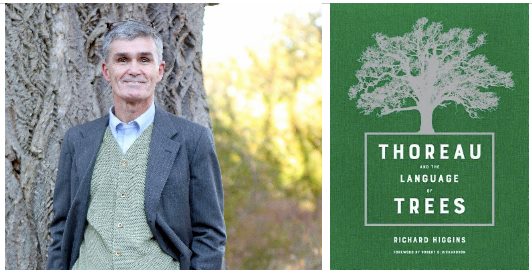
  • Saturday, April 15, 12:30 pm – 1:30 pm – Thoreau and the Language of Trees

    Richard Higgins will speak at Tower Hill Botanic Garden on Saturday, April 15 beginning at 12:30 on his new book, Thoreau and the Language of Trees. Free with admission. pre-registration requested at www.towerhillbg.org. Trees were central to Henry David Thoreau’s creativity as a writer, his work as a naturalist, his thought, and his inner life. His portraits of them were so perfect, it was as if he could see the sap flowing beneath their bark. When Thoreau wrote that the poet loves the pine tree as his own shadow in the air, he was speaking about himself. In short, he spoke their language.

    In this original book, Richard Higgins explores Thoreau’s deep connections to trees: his keen perception of them, the joy they gave him, the poetry he saw in them, his philosophical view of them, and how they fed his soul. His lively essays show that trees were a thread connecting all parts of Thoreau’s being-heart, mind, and spirit. Included are one hundred excerpts from Thoreau’s writings about trees, paired with over sixty of the author’s photographs. Thoreau’s words are as vivid now as they were in 1890, when an English naturalist wrote that he was unusually able to “to preserve the flashing forest colors in unfading light.” Thoreau and the Language of Trees shows that Thoreau, with uncanny foresight, believed trees were essential to the preservation of the world.

    Richard Higgins is a former longtime staff writer for the Boston Globe whose writing has appeared in numerous publications, including the New York Times, Atlantic Monthly, Christian Century, and Smithsonian. He lives in Concord, Massachusetts.

  • April – June, 2017 – Garlic Mustard Challenge

    The Garlic Mustard Challenge is a collaborative effort to restore and protect natural ecosystems, organized by the Stewardship Network of New England. The goal is to encourage people to get out on the land and care for local natural areas in a fun and engaging way! 2017 is our fourth year to rally volunteers across New England. Check out a summary of 2016 GM Challenge results at http://newengland.stewardshipnetwork.org/story/results-2016-garlic-mustard-challenge-new-england.  Register at http://newengland.stewardshipnetwork.org/garlic-mustard-packet-request

    Dates: Late April through early June

    Location: Anywhere in New England that garlic mustard is present.

    Who: Anyone can participate! Pull in your own backyard, in a beloved nearby conservation area, with friends, with volunteers, or with a school group.

    How: Keep track of how much or how many bags of garlic mustard you’ve pulled and report your bags!

    Questions? Email us at GMChallenge.NE@unh.edu

  • Tuesday, April 18, 7:00 pm – 8:15 pm – The Genius of Birds

    Acclaimed science and nature writer Jennifer Ackerman shares stories about her travels and cutting-edge research on the newly discovered brilliance of birds. Learn how birds craft and use tools, solve complex problems, sing to one another in regional accents, make sophisticated navigational decisions, demonstrate astonishing feats of memory, deceive one another, eavesdrop, give gifts, and even kiss to console. Discover the intelligent behavior of birds evident in our backyards, parks, city streets, and country skies around the world. The Genius of Birds will be available for purchase and signing. Free, registration requested at www.my.arboretum.harvard.edu or call 617-384-5277.

    Offered by the Arnold Arboretum and Papercuts JP . This program is part of the Cambridge Science Festival.


  • Friday, April 7, 6:45 pm – Native Orchids and Mycorrhiza: Ecologically Complex Interactions

    The New England Botanical Club will host its 2017 Distinguished Speaker Dr. Dennis Whigham, Senior Botanist, Smithsonian Environmental Research Center and North American Orchid Conservation Center, on Friday April 7, beginning at 6:45 pm. He will speak on Native Orchids and Mycorrhiza: Ecologically Complex Interactions.

    The Orchidaceae is a species-rich family of flowering plants with more than 30,000 known taxa globally. Like most terrestrial plants, orchid species interact with mycorrhizal fungi, but unlike most plants, there is little evidence that the interactions are mutualistic. Most research indicates that orchids manage the plant-fungal interactions and they consume the fungi as sources of carbon and other resources. Dependency on fungi has evolved in a number of orchid lineages to a complete dependency on fungi resulting in many species being completely mycoheterotrophic. Understanding orchid-fungal interactions is not only interesting, but it is key to orchid conservation because all orchids have, at least, one life history stage that is completely depending on fungi.

    Dennis will focus on native orchids of the U.S. and Canada to describe the ecological challenges that remain obstacles to a more complete understanding of orchid-fungal interactions. He will link issues related to orchid ecology to a Smithsonian-initiated continental-scale effort to use an ecological model to conserve native orchids through a collaborative effort that is being developed by the North American Orchid Conservation Center (NAOCC). Dennis will describe how members of the New England Botanical Club have already provided important support for NAOCC and how members can become engaged in the only effort to assure the survival of an entire plant family at a continental scale. Meetings at Harvard University are held in Haller Lecture Hall (Room 102), Geological Museum, 24 Oxford St., Cambridge, MA 02138 (door to right of Harvard Museum of Natural History entrance).  Free and open to the public.  Image from www.wabash.edu.

  • Friday, April 28 – Application Deadline for J.M.K. Innovation Prize

    The J.M.K. Innovation Prize, an initiative of the J.M. Kaplan Fund, supports social entrepreneurs across the United States who are spearheading game-changing solutions to society’s most urgent challenges. The prize considers three broad funding categories:
    * The Environment – Reducing the pace and impacts of climate change.
    * Heritage Conservation – Conserving America’s greatest monuments and places.
    * Social Justice – Supporting decarceration and humane immigrant integration.
    Visit http://www.jmkfund.org/introduction2017-j-m-k-innovation-prize/ for details.

  • Wednesday, April 12, 7:00 pm – 8:30 pm – The Songs of Trees

    Award-winning teacher and writer David George Haskell, PhD, Professor of Biology, Sewanee, The University of the South, expands his focus from one square meter (The Forest Unseen) to the expansive networked communities of life as observed in the presence of trees around the world. A keen observer of all living things, Haskell brings together ecological understanding with poetic narrative as he describes discoveries from root to branch tip, from one specimen to a forest of collaborators. Join The Arnold Arboretum on Wednesday, April 12 at 7 pm as Haskell expounds upon webs of connections that weave through the environment, human nature, science, and ethics. His book, The Songs of Trees, will be available for purchase and signing. Fees: Free Arboretum member and student; $10 nonmember.

    David George Haskell’s work integrates scientific, literary, and contemplative studies of the natural world. He is a professor at the University of the South and a Guggenheim Fellow. A profile in The New York Times said of Haskell that he “thinks like a biologist, writes like a poet, and gives the natural world the kind of open-minded attention one expects from a Zen monk rather than a hypothesis-driven scientist.”

    Offered with the Harvard Museums of Science and Culture. Register at my.arboretum.harvard.edu or call 617-384-5277.

  • Friday, April 7, 1:30 pm – Hope Floats on White: White Gardens

    This illustrated lecture on Friday, April 7 at the Wellesley College Botanic Gardens by author and garden designer Carol Julien (www.caroljulien.org) features the design techniques for creating a white garden. Carol discusses what is considered one of the finest gardens of the last 100 years: the White Garden at Sissinghurst Castle in England. She describes her 1,000 square foot white garden in Halifax, MA, and will distribute a plant list for creating your own white garden. Friends of the Wellesley College Botanic Garden: free; nonmembers $10. Pre-registration required.  Read more at http://www.wellesley.edu/wcbg/learn/adult_education#gdScv5mOfLKcOHWu.99

  • Wednesday, April 12, 5:00 pm – 47th Annual Meeting of the Friends of the Public Garden

    Wednesday, April 12, 5:00 pm – 47th Annual Meeting of the Friends of the Public Garden

    The 47th Annual Meeting of the Friends of the Public Garden will be held Wednesday, April 12 beginning at 5 pm at First Church in Boston, 66 Marlborough Street, Boston.  Featured will be Alex Krieger, FAIA, principal of architecture firm BBJ, Professor at the Harvard School of Design and recent recipient of the Boston Society of Architects’ Award of Honor, who will speak on The New Allure of the City, and Some Unanticipated Consequences.  Reception to follow.  Kindly rsvp by April 5 by calling 617-723-8144, or email rsvp@friendsofthepublicgarden.org.  Visit www.friendsofthepublicgarden.org for last year’s Annual Meeting minutes, Bylaws, and the Board of Directors nominating slate.


  • Saturday, April 8, 10:00 am – 12:00 noon and 1:00 pm – 3:00 pm – Home Orchard Establishment and Pest Management

    Mass Aggie Seminars 2017 resume Saturday, April 8 with two back to back hands-on programs in Sherborn. The first, Home Orchard Establishment & Basics, will run from 10 – noon, and the second, Home Orchard Pest Management, runs from 1 – 3.  You may sign up for either workshop for a fee of $45, or both for a discount of $80.  The location is Dowse Orchards, 98 North Main Street in Sherborn (508-653-2639).

    Horticultural topics covered will be the basics of planting fruit trees, including site selection, choice of variety and rootstock, planting best practices, tree training and pruning, fertilization and ongoing fruit tree care. (In-depth pest management will be covered in the afternoon session.) If weather permits, there will be a hands-on demonstration of planting fruit trees at Dowse Orchards. One of the most challenging thing about growing your own fruit is knowing how to identify the insect pests and diseases that might afflict them. Learn the basics of pest and disease identification and Integrated Pest Management (IPM) in the home orchard. Hands-on, scouting, monitoring, placement of traps, etc. will be covered.

    These workshops will be partially out of doors, so please dress appropriately for potentially wet, cold, and muddy conditions. THANK YOU to SPONSORS: Nourse Farms, OESCO,Inc., and Adams County Nursery.

    Register and pay via credit card for any of the Mass Aggie seminars by visiting https://www.regonline.com/builder/site/?eventid=1917452 . You will be taken to a secure RegOnline site where you will be able to choose which seminars you wish to attend and to pay. You will receive an e-mail receipt of your transaction. If you do not wish to register and pay online, you may print a registration form to mail. Click on http://ag.umass.edu/sites/ag.umass.edu/files/pdf-doc-ppt/mass_aggie_flyer_2017.pdf , and you will open a pdf version of the registration form. You can print this form, select the seminars that you wish to attend, and mail it with a check for the appropriate amount.