Tag: Cambridge Entomological Club

  • Tuesday, January 13, 7:30 pm – The Bee: A Natural History

    The January meeting of the Cambridge Entomological Club will take place Tuesday, January 13 at 7:30 pm in Room 101 of the Museum of Comparative Zoology, 26 Oxford Street, Cambridge.  The speaker will be Noah Wilson-Rich, the founder of The Best Bees Company and author of The Bee: A Natural History.  The meeting is free and open to the public.  Snacks will be provided, and you are welcome to join the group at 6 pm for an informal pre-meeting dinner at Cambridge Common.  For more information email Shayla Salzman at shaylasalzman@FAS.harvard.edu.

  • Tuesday, October 14, 7:30 pm – Fossil Insects: Learning from the Past

    On Tuesday, October 14th at 07:30 PM in room 101 of the Museum of Comparative Zoology, 26 Oxford Street in Cambridge, Ricardo Pérez de la Fuente of Harvard University will address the Cambridge Entomological Club about Fossil Insects: Learning from the past.

    Insects are one of the main biological sources of environmental, ecological, and evolutionary information concerning life on land as archived in the geological record from ca. 400 million years ago. Although the study of extinct insects is challenging, it can be surprisingly similar to the study of extant specimens thanks to the discovery of fossils with exceptional preservation, like amber inclusions, and the use of new techniques. As the legacy of an old paleoentomological tradition that started with the classic works of Samuel H. Scudder, co-founder of the Cambridge Entomological Club and its journal Psyche, the Museum of Contemporary Zoology has one of the premier fossil insect collections worldwide, composed of more than 30,000 specimens and 3,000 types. But what can we really learn from fossil insects? And to what extent are they reliable? Together we will try to answer these and more questions in the forthcoming talk.

    The meeting is free and open to the public. Snacks will be provided and you are also welcome to join Club members at 6:00 PM for an informal pre-meeting dinner at the Cambridge Common. For more information contact CEC Vice-President Shayla Salzman at shaylasalzman@fas.harvard.edu.

  • Tuesday, May 13, 7:30 pm – Weevil Diversity: Beyond the 60,000 Names

    The Annual Meeting of the Cambridge Entomological Club will be held Tuesday, May 13, beginning at 7:30 pm in Room 101 of the Museum of Comparative Zoology, Oxford Street, Cambridge.  Bruno de Medeiros will give the traditional President’s address, this year entitled Weevil Diversity: Beyond the 60,000 Names.

    Many people know about horned scarab beetles fighting for females, or insect predators such a praying mantises that can be cannibals. What is less well-known is that similar stories can be found among the seemingly uninteresting plant-feeding beetles known as weevils. Weevils stand out as a very diverse group in terms of number of species – in fact, they are the most diverse family of animals. However, they are much more than a bunch of names, and weevil natural history can also be very interesting and sometimes even surprising. In this talk Bruno will share some stories that he found while doing research on palm-associated weevils during the last few years, and also the adventures that he went through while chasing them in Brazil.

    The meeting is free and open to the public. Snacks will be provided and you are also welcome to join us at 6:00 PM for an informal pre-meeting dinner at the Cambridge Common.

  • Tuesday, April 8, 7:30 pm – The American Natural History Tradition

    Tuesday, April 8, 7:30 pm – The American Natural History Tradition

    The April meeting of the Cambridge Entomological Club will be held Tuesday, April 8 at 7:30 pm in Room 101 of the Museum of Comparative Zoology, Oxford Street, Cambridge. Professor William Leach will present a talk about the American Natural History Tradition.

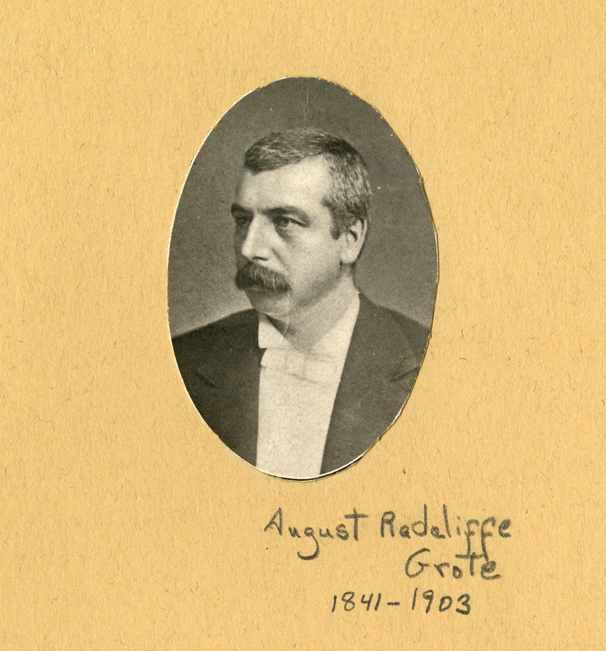
    If we want to understand why Americans started to collect and study butterflies in the 19th century, we must first understand the evolution of natural history itself. Originating in Europe and England, natural history acted as a language of interpretation and as a way of understanding nature that opened it up. It revealed to Americans what butterflies were all about and why they mattered and were worthy of study and reflection. By the 1870s a brilliant group of American butterfly men had emerged, their ideas forged within the heart of this tradition. They made a profound contribution to natural history, bringing to it a radical Darwinian analysis and a passion for life histories perhaps unrivaled by any of their contemporaries. This talk will examine the character of natural history in America between 1865 and 1885 and the way men such as William Henry Edwards, Benjamin Walsh, (former CEC president) Samuel Scudder, Herman Strecker, Augustus Radcliffe Grote (pictured below,) and William Doherty transformed and enriched it.

    The meeting is free and open to the public. Snacks will be provided and you are also welcome to join us at 6:00 PM for an informal pre-meeting dinner at the Cambridge Common.

    Augustus_Radcliffe_Grote_entomologist

  • Tuesday, February 11, 7:30 pm – Phyto-Predation and Phylogeny of Lepidochrysops Butterflies and Relatives

    Yes, you read that right. February’s Cambridge Entomological Club meeting will be held on Tuesday the 11th at 07:30 PM in in room 101 of the Museum of Comparative Zoology. Dr Marianne Espeland will present a talk entitled From host plants to host ants: phyto-predation and phylogeny of Lepidochrysops butterflies and relatives.

    More than 99.99% of the approximately 200,000 described Lepidoptera species are phytophagous. Only around 500 species are aphytophagous and feed mainly on other insects or their secretions. Aphytophagy is most common in the butterfly family Lycaenidae where it has evolved independently several times, but mostly as single species in otherwise phytophagous clades. One exception is the Afrotropical genus Lepidochrysops, with 137 described species, all assumed to be predaceous on ant brood or fed by trophallaxis from the third instar until pupation. Little is known about their life history, the relationships among the five genera in the Euchrysops section, and even less about the relationships among species within Lepidochrysops. Dr Espeland’s aim is to infer a phylogeny of the Euchrysops section and answer questions about the evolution of predation and diversification of the group.

    If you can make head or tail of that description, the meeting is free and open to the public. Snacks will be provided and you are also welcome to join us at 6:00 PM for an informal pre-meeting dinner at the Cambridge Common.

    http://www.learnaboutbutterflies.com/Lepidochrysops%20quassi%207328-001a.jpg

  • Tuesday, January 14, 7:30 pm – A Heads-Up View of Urban Stream Ecology

    The next meeting of the Cambridge Entomological Club will take place Tuesday, January 14, beginning at 7:30 in room 101 of the Museum of Comparative Zoology, Oxford Street, Cambridge. Dr Bob Smith will present a talk entitled A Heads-up View of Urban Stream Ecology.

    Human activities in the watershed and direct alterations to the stream channel can alter the habitat and water quality experienced by fauna living in a stream. Thus, studies examining stream communities along an urbanization gradient typically focus on the links between watershed land-use and in-stream conditions. However, stream organisms are not confined to a single stretch of stream throughout their life. Fish have the ability to disperse long distance through the stream network, and flying insects can disperse long distances across the landscape, unconstrained by the stream network.

    Using a combination of field studies and GIS, Dr Smith investigated how dispersal (a regional process) affects patterns of stream biodiversity along a gradient of human influence. His research suggests that human land use across the landscape may impede dispersal and both local (watershed based) and regional (dispersal based) processes are important for controlling community structure in urbanized streams. The mechanisms for how human activities alter regional processes differ between taxa and are related to species life history traits. These findings have important implications for conservation and restoration strategies as well as developing land-use development plans that promote the sustainability of stream ecosystems.

    The meeting is free and open to the public. Snacks will be provided and you are also welcome to join us at 6:00 PM for an informal pre-meeting dinner at the Cambridge Common.

    http://all-geo.org/highlyallochthonous//srv/htdocs/wp-content/uploads/2010/07/urban_restoration2.jpg

  • Tuesday, November 12, 7:30 pm – Engineering and Reverse-Engineering Insect Flight

    The next meeting of the Cambridge Entomological Club will be held on Tuesday, November 12 at 07:30 PM in in room 101 of the Museum of Comparative Zoology, 24 Oxford Street in Cambridge. Andrew Mountcastle and Sawyer Fuller will present a talk entitled Engineering and Reverse-Engineering Insect Flight.

    Flapping flight is one of the key innovations which make insects the most successful group of animals on the planet, and it has captivated engineers who wish to build micro air vehicles capable of similar performance. In this broad-ranging presentation, Drs. Mountcastle and Fuller will talk about their research on insect flight. Dr. Mountcastle will talk about insect wing form and function. Insect wings are flexible structures that bend and twist in ways that are actually adaptive for a variety of functional demands. He will show how wing flexibility enhances load-lifting and aerodynamic force production in bumblebees, and also helps mitigate collision damage in the wings of wasps and bumblebees.

    Dr. Fuller will talk about how these animals use their tiny, low resolution eyes to sense their motion and control flight, and how to build robots inspired by their control strategies. He will show how he and his colleagues control a Robobee (picture below,) an insect-sized flapping-wing flying vehicle the sized of a bumblebee, using a small number of visual sensors. He will also talk about how flies control their forward velocity using both vision and wind sensing because vision alone is too slow. This research approach is what Sawyer calls “cyclic biological robotics” – studying biology for robotic inspiration, using this robotics to bring up refined questions for biology, and repeating.

    The meeting is free and open to the public. Snacks will be provided and you are also welcome to join us at 6:00 PM for an informal pre-meeting dinner at Cambridge Common.

    http://www.secretsofthefed.com//srv/htdocs/wp-content/uploads/2013/05/Robobee-Micro-Air-Vehicle-2-537x356.jpg

  • Tuesday, October 8, 7:30 pm – Queens, Potential Queens, and Temporary Workers in a Tropical Paper Wasp Species

    The next meeting of the Cambridge Entomological Club  will be held on Tuesday, October 8 at 7:30 PM in in room 101 of the Museum of Comparative Zoology, 26 Oxford Street in Cambridge. Shantanu Shukla will present a talk entitled “Queens, potential queens, and temporary workers in a tropical paper wasp species”.

    Ropalidia marginata is a primitively eusocial wasp from southern and south-eastern Asia. Queens and the workers are morphologically similar, and reproductive castes are flexible. Queens are the sole egg layers in the colony, but workers retain the capacity to fully develop ovaries and become queens. What distinguishes this species is that the queen is not the dominant female, but is meek and docile. How then does the queen maintain her reproductive dominance? How does the colony regulate its maintenance and care? If workers are capable of becoming queens, why don’t they do so?  Dr. Shukla will demonstrate how he has used behavioral experiments to elucidate the mysteries of these complex and fascinating social insects.

    The meeting is free and open to the public. Snacks will be provided and you are also welcome to join us at 6:00 PM for an informal pre-meeting dinner at Cambridge Common. Image below from www.treknature.com.

    http://i1.treknature.com/photos/13984/paper-wasp.jpg
  • Tuesday, September 10, 1:00 pm – 9:00 pm – Bee Day at Harvard

    On Tuesday, September 10, participate in a day of events and activities highlighting the importance of honey bees and beekeeping to biodiversity, the food supply, and human health. Learn more about the alarming decline of beehives (colony collapse disorder) widely documented in the U.S. and Europe.

    Event Schedule
    1:00–2:00 pm: The Plaza (in front of the Science Center)
    Enjoy organic honey tasting at the Harvard Farmers’ Market.

    4:00 pm
    Take a tour of the beehives on Harvard’s campus, led by Harvard Undergraduate Beekeepers. Preregistration required; please visit the HMSC website for more information: www.hmsc.harvard.edu.

    7:00 pm: Science Center, Hall C
    Film screening of More Than Honey, followed by a discussion with Dr. Alex Lu, Associate Professor of Environmental Exposure Biology, Harvard School of Public Health, about current research on the link between colony collapse disorder and the use of agricultural pesticides.

    Jointly sponsored by the Harvard Museum of Natural History, Harvard Undergraduate Beekeepers, the Harvard Farmers’ Market, the Food Literacy Project, and the Cambridge Entomological Club.

    All activities and events are free and open to the public. The Plaza and the Science Center, 1 Oxford Street. Free event parking is available at the 52 Oxford Street Garage. For more information, visit www.hmnh.harvard.edu.

    http://trailers.apple.com/trailers/independent/morethanhoney/images/poster-xlarge.jpg

  • Tuesday, February 12, 7:30 pm – Two Centuries of Jumping Spider Studies in Massachusetts

    The next meeting of the Cambridge Entomological Club  will be held on Tuesday February 12 at 07:30 PM in room 101 of the Museum of Comparative Zoology. Dick Walton will present a talk entitled “Two Centuries of Jumping Spider (Araneae: Salticidae) Studies in Massachusetts”.

    Worldwide the salticids comprise the largest spider family with approximately 300 species represented in North America north of Mexico. Superior eyesight, an active lifestyle, diversity of forms, colors and behaviors are all hallmarks of this group. Dick Walton will present a brief history of salticid studies in MA as well as an overview of jumping spiders present in MA today. In addition, he will show us several of his videos portraying these amazing creatures.

    The meeting is free and open to the public. Snacks will be provided and you are also welcome to join us at 6:00 PM for an informal pre-meeting dinner at West Side Lounge Restaurant.  Photo from www.thegardenerseden.com.

    http://www.thegardenerseden.com//srv/htdocs/wp-content/uploads/2010/10/Jumping-Spider-%E2%93%92-Tim-Geiss.jpg